


As businesses continue moving critical workloads to the cloud, one critical decision often determines the long-term success of their infrastructure:
Should you manage your cloud environment internally, or partner with a managed cloud service provider?
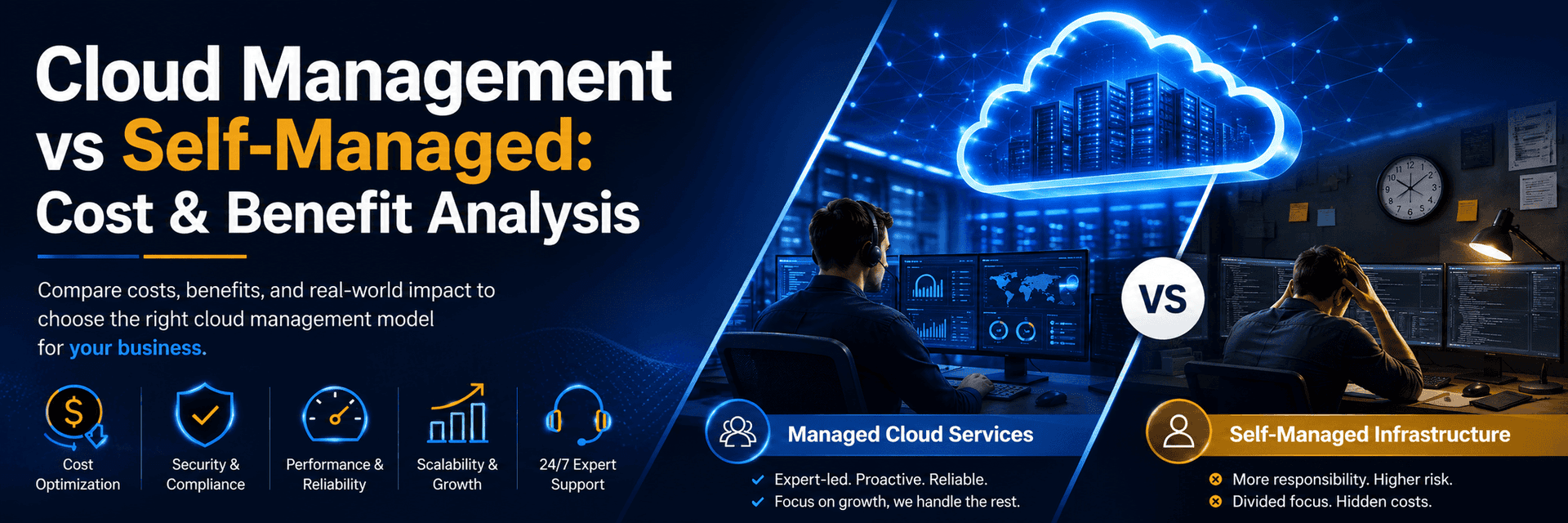
While self-managed cloud infrastructure offers total control, it also demands significant technical expertise, continuous monitoring, and a massive chunk of your operational resources. Managed cloud services, on the other hand, allow businesses to offload the heavy lifting of infrastructure management to experienced cloud engineers, freeing up internal teams to focus on what they do best: driving core business growth.
There is no universal answer. The right choice depends entirely on your organization's size, technical capabilities, operational priorities, and long-term growth strategy. In this guide, we'll break down the realities of cloud management vs self-managed infrastructure, explore the hidden costs and benefits of each approach, and help you determine which model truly fits your business.
What is Self-Managed Cloud Infrastructure?
A self-managed cloud environment means your internal IT or DevOps team handles the day-to-day operations and takes full ownership of the cloud infrastructure.
While cloud providers (like AWS, Azure, or Google Cloud) handle the physical data centers and hardware, everything running inside your cloud environment becomes your responsibility. This typically includes:
● Infrastructure & Provisioning
Setting up servers, configuring networks, and managing storage.
● Maintenance & Updates
Handling operating system management, security patches, and version updates.
● Business Continuity
Backup management, disaster recovery planning, and capacity planning.
● Day-to-Day Operations
Continuous infrastructure monitoring, performance optimization, and incident response.
● Financial Oversight
Cloud cost management and resource allocation.
Essentially, you aren't just buying cloud space, you are building and maintaining the digital house that sits on it.
What are Managed Cloud Services?
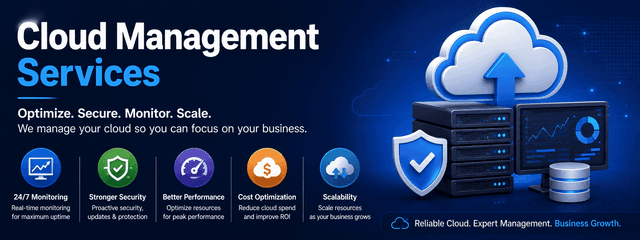
Managed cloud services involve partnering with an experienced cloud operations team that takes over the heavy lifting of managing, maintaining, and scaling your cloud infrastructure on your behalf.
Instead of stretching your internal IT resources thin, you gain access to a dedicated squad of cloud engineers who proactively look after your environment. Depending on your specific requirements, managed cloud services generally encompass:
● Around-the-Clock Vigilance
24/7 infrastructure monitoring and rapid incident response.
● Advanced Administration
Linux server administration and Kubernetes management.
● Security & Compliance
Security hardening, regular patching, and disaster recovery planning.
● Efficiency & Scaling
Cloud performance optimization, infrastructure automation, and cloud cost optimization.
● Strategic Assistance
Ongoing operational support tailored to your business needs.
Think of it as having an elite cloud operations department on standby, ensuring your systems run flawlessly without the overhead of building that team from scratch.
Cloud Management vs Self-Managed: What's the Difference?
Although both approaches utilize the exact same cloud platforms, the operational reality and where the buck stops differ significantly.
| Feature | Self-Managed Cloud | Managed Cloud Services |
| Operational Control | Internal team manages infrastructure | Dedicated cloud experts manage operations |
| Talent Pool | Requires deep, in-house expertise | Instant access to experienced cloud engineers |
| Support Hours | Limited support outside business hours | 24/7 monitoring and incident response |
| Maintenance Style | Internal responsibility for maintenance | Proactive infrastructure management |
| Security Handling | Business handles security and updates | Security management and best practices included |
| Monitoring | Internal monitoring tools setup by you | Continuous, managed infrastructure monitoring |
Ultimately, the biggest difference is not the underlying technology, it's who is responsible for keeping your infrastructure secure, available, and cost-effective around the clock.
Cost Analysis: Self-Managed Cloud vs Managed Cloud Services
Many businesses fall into the trap of assuming that self-managing cloud infrastructure is the cheaper option. In reality, the total cost of ownership (TCO) often extends far beyond your monthly cloud provider invoices.
Costs of Self-Managed Cloud Infrastructure
When you choose to fly solo, your budget must account for a variety of ongoing operational expenses:
● Human Capital
Internal engineering salaries, benefits, and competitive compensation for top-tier DevOps talent.
● On-Call Strains
Overtime pay or additional hiring required to cover true 24/7 on-call support.
● The Tech Stack
Licensing fees for third-party infrastructure monitoring tools, security solutions, and backup platforms.
● Skill Gaps
The continuous cost of training and certifications to keep up with evolving cloud tech.
● The Unknowns
Hidden downtime costs and massive productivity losses during major outages or security incidents.
Costs of Managed Cloud Services
Managed cloud services simplify your financial planning by trading unpredictable operational spikes for predictable monthly fees. This fixed cost covers:
● Continuous infrastructure monitoring and proactive performance optimization.
● Instant incident response and expert server administration.
● Comprehensive security management and ongoing operational support.
Rather than trying to hire, train, and retain multiple specialists to cover every layer of your stack, businesses gain access to an entire team of experts through a single, predictable service engagement.
Benefits of Self-Managed Cloud Infrastructure
For certain organizations, keeping the keys to the kingdom internally offers distinct advantages
Complete Operational Control
Internal teams maintain total autonomy over every single digital brick they lay down. This includes absolute control over infrastructure configurations, customized deployment schedules, rigid internal security policies, change management, and niche technology selection. For organizations running highly specialized, deeply proprietary, or highly sensitive environments, this hyper-granular flexibility can be beneficial.
Internal Knowledge Development
Managing infrastructure internally creates an intense learning environment that builds deep cloud expertise within your organization. Engineering teams gain invaluable, hands-on experience with advanced cloud architecture, bespoke automation, performance tuning, and security operations. For technology-first companies whose primary product is the infrastructure, this institutional knowledge can turn into a powerful long-term strategic advantage.
Challenges of Self-Managed Cloud Infrastructure
Despite the appeal of total control, self-management introduces steep operational hurdles that can stall a growing business.
Limited 24/7 Coverage
Most mid-sized businesses operate with relatively small IT teams. When a critical infrastructure issue strikes at 2:00 AM on a Sunday, standard internal teams are rarely equipped to handle it immediately. This leads to extended downtime, delayed incident response, negative customer impact, and costly Service Level Agreement (SLA) violations.
Increased Operational Overhead
When engineers are forced to spend their days playing digital janitor managing operating system updates, chasing security patches, verifying backups, and troubleshooting performance blips, they aren't building new features. This heavy operational tax drastically reduces the time your team has available for innovation and revenue-generating projects.
Difficulty Scaling Operations
As your business grows, your infrastructure grows with it and complexity increases exponentially. Managing dozens or hundreds of cloud instances requires standardized processes, robust automation, and dedicated operations personnel. Without an enterprise-grade framework already in place, scaling up infrastructure quickly turns into an administrative nightmare.

Benefits of Managed Cloud Services
Partnering with a specialized managed cloud provider changes the equation from reactive troubleshooting to proactive growth.
24/7 Infrastructure Monitoring
True peace of mind comes from continuous, proactive monitoring that catches anomalies before they balloon into customer-facing disasters. Managed services track your system's vital signs in real-time, including:
● CPU utilization and memory usage
● Disk capacity and database health
● Service availability and website uptime
● Security events and backup verifications
Access to Experienced Cloud Engineers
Managed cloud providers live and breathe cloud ecosystems every single day. Because they solve complex infrastructure puzzles across diverse industries, they bring a wealth of collective knowledge to your business. This allows you to resolve incidents faster, easily optimize system performance, dramatically reduce operational risks, and implement industry best practices right from the start.
Improved Security and Compliance
Cloud security is never a "set-it-and-forget-it" task; it requires relentless, daily attention. Managed services ensure your environment stays hardened against threats by handling day-to-day security patching, OS updates, firewall management, access control, and compliance best practices. This proactive posture keeps you steps ahead of vulnerabilities.
Predictable Operational Costs
Financial predictability is a major relief for growing businesses. By consolidating your operational support into a single service fee, you eliminate the threat of unexpected costs associated with emergency consultants, frantic overtime staffing during an outage, or sudden infrastructure failures.
When Should You Choose Self-Managed Cloud Infrastructure?
Self-management makes the most sense for organizations that fit a specific operational profile. You should lean toward this model if you:
● Already employ a robust team of experienced cloud engineers.
● Maintain a fully dedicated, mature DevOps department.
● Require absolute, unfiltered operational control for regulatory or proprietary reasons.
● Operate highly customized, non-standard software environments.
● Can comfortably sustain true 24/7/365 operational coverage without burning out your staff.
When Should You Choose Managed Cloud Services?
For the vast majority of scaling companies, partnering with an expert is the logical path forward. Managed cloud services are ideal for businesses that:
● Lack deep, in-house cloud architecture or administration expertise.
● Need immediate, reliable 24/7 operational support and faster incident response times.
● Want to systematically reduce operational overhead and eliminate technical debt.
● Require proactive, round-the-clock infrastructure monitoring.
● Want highly predictable operational expenses for easier budgeting.
● Prefer focusing their internal energy on business growth and software innovation rather than server maintenance.
Ultimately, it provides enterprise-grade operational muscle without the enterprise-grade price tag of building a massive internal team.
Can Businesses Use Both Models?
Absolutely and in fact, many of the most successful organizations choose this hybrid operational path.
Instead of an all-or-nothing choice, businesses split the workload strategically. Your internal engineering team focuses its energy on product development, application improvements, and core business innovation. Meanwhile, your managed cloud provider acts as the foundational support system, quietly handling infrastructure monitoring, Linux administration, rapid incident response, security management, and routine maintenance in the background.
This co-managed approach gives you the best of both worlds: total control over your product and peak operational efficiency for your infrastructure.
How SupportSages Helps Businesses Manage Cloud Infrastructure
At SupportSages, our managed cloud operations are engineered to give businesses secure, high-performing, and resilient cloud environments without the headaches of self-management. We don't believe in generic setups; we align our expertise directly with your unique operational goals.
Depending on what your business needs to thrive, SupportSages delivers across two core pillars:
Managed Cloud Services
● Proactive Administration
24/7 infrastructure monitoring and expert Linux server administration.
● Rapid Defense
Swift incident response, performance optimization, and security-focused operations.
● Advanced Architecture
Deep Kubernetes support along with robust backup and disaster recovery assistance.
Cloud Operations Support
● Seamless Transitions
Smooth cloud-to-cloud migration with dedicated post-migration support.
● Strategic Planning
Thorough infrastructure optimization and proactive capacity planning.
● Expert Guidance
Hands-on operational consulting to align your tech with your business roadmap.
By blending continuous monitoring with decades of collective cloud experience, SupportSages helps you drive down downtime, unlock peak performance, and get back to growing your business.
Questions to Ask Before Choosing a Cloud Management Model
Before making your final choice, gather your leadership team and ask these critical questions:
1. Does our internal team truly possess the specialized cloud expertise needed for our long-term roadmap?
2. Can we realistically provide reliable, 24/7 operational coverage without burning out our best engineers?
3. Exactly how much downtime can our business and our customers tolerated before it hurts our bottom line?
4. Are our monthly cloud costs being actively, strategically optimized, or are we overpaying for idle resources?
5. Does our team actually have the hours required to manage infrastructure proactively, or are they constantly stuck in firefighting mode?
6. Would our engineers deliver significantly higher business value if they focused 100% on product innovation instead of server maintenance?
Your answers to these questions will cleanly highlight which operational model naturally aligns with your business objectives.
Final Thoughts
Choosing between cloud management vs self-managed infrastructure is rarely just a technical decision. It is a foundational business strategy.
Going the self-managed route gives you total control over the environment, but it binds your organization to intense talent acquisition challenges, constant maintenance cycles, and heavy operational risks. Managed cloud services flip the script, offering proactive monitoring, elite engineering talent, bulletproof security, and predictable costs so your business can move faster.
As cloud environments grow more complex by the day, smart organizations are realizing that they don't need to own the burden of infrastructure maintenance to reap its rewards. Partnering with a trusted managed cloud provider delivers the ultimate corporate asset: the freedom to innovate without distractions.