


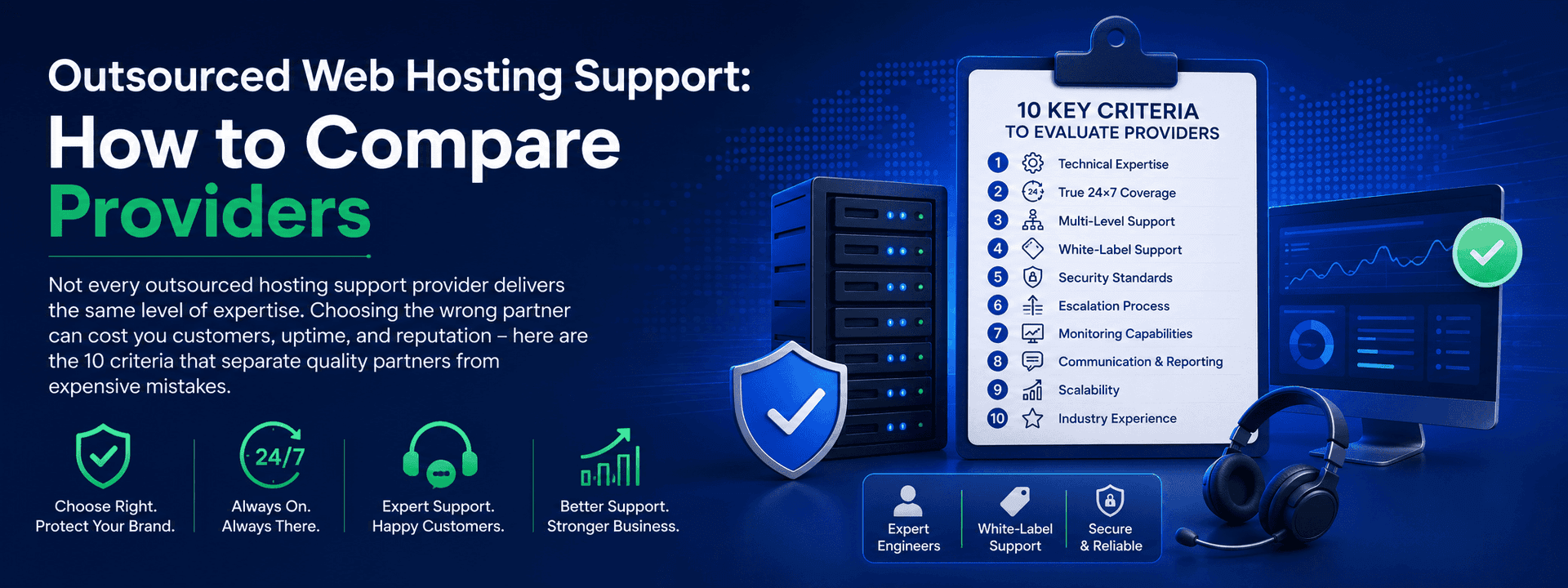
Not every outsourced hosting support provider delivers the same level of expertise. Choosing the wrong partner can cost you customers, uptime, and reputation - here are the 10 criteria that separate quality partners from expensive mistakes.
Introduction
Not every outsourced hosting support provider delivers the same level of expertise. Choosing the wrong partner can result in slow response times, inconsistent customer experiences, security vulnerabilities, and operational risks that are far more damaging than whatever you saved on headcount.
Selecting the right provider requires a rigorous evaluation - not just of their marketing claims, but of their technical capabilities, operational maturity, security posture, and genuine capacity to scale alongside your business.
This guide walks through the ten criteria that should anchor every outsourced hosting support evaluation, with specific questions to ask each prospective partner and the red flags that should disqualify them from consideration.
Why Choosing the Right Provider Matters
https://www.supportsages.com/blog/what-is-outsourced-web-hosting-support
Not every outsourced hosting support provider delivers the same level of expertise. Choosing the wrong partner can result in slow response times, inconsistent customer experiences, security vulnerabilities, and operational risks that are far more damaging than whatever you saved on headcount.
Selecting the right provider requires a rigorous evaluation - not just of their marketing claims, but of their technical capabilities, operational maturity, security posture, and genuine capacity to scale alongside your business.
This guide walks through the ten criteria that should anchor every outsourced hosting support evaluation, with specific questions to ask each prospective partner and the red flags that should disqualify them from consideration.
The hidden risk: Many hosting companies discover provider quality issues only after a significant customer escalation or public-facing outage. By that point, the reputational damage is already done. A meticulous upfront selection process is the only reliable way to protect against this.
The following ten criteria are the result of what genuinely separates reliable, outsourced hosting support partners from providers that look credible on paper but underdeliver in production.
10 Key Criteria for Evaluating Outsourced Hosting Support
1. Technical Expertise
Your provider must be fluent in the specific technologies your infrastructure relies on - not just generically "experienced with Linux." Ensure they have proven capabilities across the control panels you use (cPanel, Plesk, DirectAdmin), the web servers in your stack (Nginx, LiteSpeed, Apache), the cloud platforms your clients run on (AWS, GCP, Azure), and hosting-specific layers like CloudLinux and WHM.
Ask for specific examples of complex issues they've resolved in each of these environments, not just confirmation that they support them. Technical expertise that exists only in a sales deck is a significant operational risk.
2. True 24×7 Coverage
"Available 24/7" is one of the most overused and least meaningful claims in the outsourced support market. Availability and full staffing are not the same thing. You need to understand the actual logistics behind the claim: how many shifts they run, minimum engineer headcount on night and weekend shifts, how they cover major international holidays, and what their escalation path looks like at 3 AM when a critical issue requires L3 involvement.
A provider whose "24/7" coverage means one on-call engineer monitoring an alert queue is not the same as a fully staffed NOC with dedicated overnight engineering capacity.
3. Multi-Level Support
A robust partner maintains a clear escalation structure with defined capabilities at each tier. This isn't just organisational tidiness - it's the primary mechanism for keeping MTTR low and ensuring that the right level of expertise is engaged at the right moment.
- L1 Frontline
Basic troubleshooting, password resets, account queries, and standard ticket routing. First point of contact for all inbound issues. - L2 Intermediate
Deeper server investigations, configuration adjustments, performance diagnostics, and issues that require SSH-level access and technical judgment. - L3 Advanced
Complex infrastructure failures, kernel panics, advanced cloud architecture issues, and anything requiring senior engineering-level intervention.
4. White-Label Support
Your end customers should never know they are speaking to an outsourced team. True white-label support requires the provider to operate entirely within your helpdesk system, use your email signatures and brand voice, follow your established SOPs, and maintain the same communication style your customers are accustomed to.
This goes beyond cosmetics. The provider needs to understand your product offering well enough to respond accurately on your behalf - including your specific hosting plans, upgrade paths, and policies. A provider who asks customers to "check with your hosting company" on account-level questions has not properly integrated as a white-label partner.
5. Security Standards
When you engage an outsourced hosting support provider, you are granting them access to your server infrastructure and, by extension, your customers' data. The security posture of your partner becomes your security posture. This is not an area where vague reassurances are acceptable.
Require ISO 27001 certification as a baseline. Beyond that, look for signed NDAs with clear data handling clauses, Multi-Factor Authentication (MFA) enforced for all system access, role-based access controls that limit engineer permissions to only what their tier requires, and transparent audit logging so you can see exactly who accessed what and when.

6. Escalation Process
When a critical server goes down, every second counts. A provider without a structured, tested escalation process for severe incidents will improvise under pressure - which is exactly when improvisation is most expensive. You need to understand their guaranteed response time for critical incidents, their methodology for managing severe outages, how they communicate with your internal team during a crisis, and what authority they have to take action without waiting for approval.
Ask for a recent example of how they handled a critical outage, including the timeline from alert to resolution and the communication sent to the client. How a provider tells that story tells you a great deal about their operational maturity.
7. Monitoring Capabilities
Support should not be purely reactive. A quality partner proactively monitors your infrastructure to identify and resolve degradation before it triggers customer-facing incidents. This means comprehensive server monitoring across CPU, memory, disk, and network; application-layer alerting for web server errors and database performance; and early-warning systems that catch problems in their early stages rather than after the first customer complaint.
Ask specifically about what monitoring tooling they use, what thresholds trigger alerts, and how they handle false-positive rates that cause alert fatigue - a real operational problem in environments with generic monitoring configurations.
8. Communication & Reporting
Transparency is not optional in an outsourced partnership - it's the mechanism that replaces the visibility you'd naturally have with an in-house team. A quality provider delivers weekly operational reviews covering SLA compliance and ticket trends, detailed monthly performance reports with first-contact resolution rates and MTTR data, and thorough root-cause analysis documentation following any major incident.
You should always know how your support operation is performing, what the most common recurring issues are, and what actions the provider is taking to address systemic problems. If a prospective partner cannot describe their reporting structure in specific detail, that is a red flag.
9. Scalability
Your support requirements will change. A marketing campaign, a new enterprise client, or rapid organic growth can multiply ticket volumes in a short window. Your provider needs to absorb these spikes without degradation in response quality or SLA compliance - and conversely, during quieter periods, the engagement model should not leave you paying for idle capacity you're not using.
Ask how they've handled volume spikes for existing clients, what their operational bandwidth looks like at full capacity, and what their ramp-up timeline is for significantly increased coverage requirements.
10. Industry Experience
Web hosting is a technically specific niche with its own operational patterns, common failure modes, and customer expectations. A general-purpose IT support provider without deep hosting experience will struggle with the nuances: shared hosting resource contention, VPS node management, cPanel licensing edge cases, reseller account structures, and the particular urgency customers feel when their business website or email goes down.
Hosting-specific experience is not just about technical knowledge - it's about support culture. Engineers who understand the emotional stakes for a small business owner whose site is down at midnight respond differently and more effectively than those who treat it like a generic IT ticket.
Why Businesses Choose SupportSages
At SupportSages, we don't rely on marketing claims - we rely on technical excellence and operational transparency. Every criterion in this guide reflects how we have structured our own service delivery.
Our hosting-focused engineers carry deep L1, L2, and L3 expertise across cPanel, Plesk, DirectAdmin, CloudLinux, LiteSpeed, and major cloud platforms. Our white-label support integrates seamlessly into your helpdesk, operating under your brand from day one. ISO 27001-certified security processes and MFA-enforced access controls govern every client engagement. A dedicated Technical Account Manager provides your single point of accountability, supported by weekly operational reviews and detailed monthly performance reporting.
We also offer a structured onboarding and shadow period so you can evaluate our response quality against your brand standards before we go live - because a provider confident in their quality should welcome the scrutiny.
Selection as a Strategic Decision
Selecting an outsourced hosting support provider is more than a procurement decision it is a long-term partnership that directly influences your customers' experience, your operational stability, and your brand reputation. Technical expertise, security standards, escalation processes, communication, and scalability should all carry equal weight when evaluating potential providers.
A trustworthy partner will be transparent about their capabilities, demonstrate proven experience, and integrate seamlessly with your existing operations rather than simply promising 24/7 support. By evaluating providers against clear technical and operational criteria, hosting companies can build a support partnership that not only resolves today's challenges but also supports sustainable business growth for years to come.