


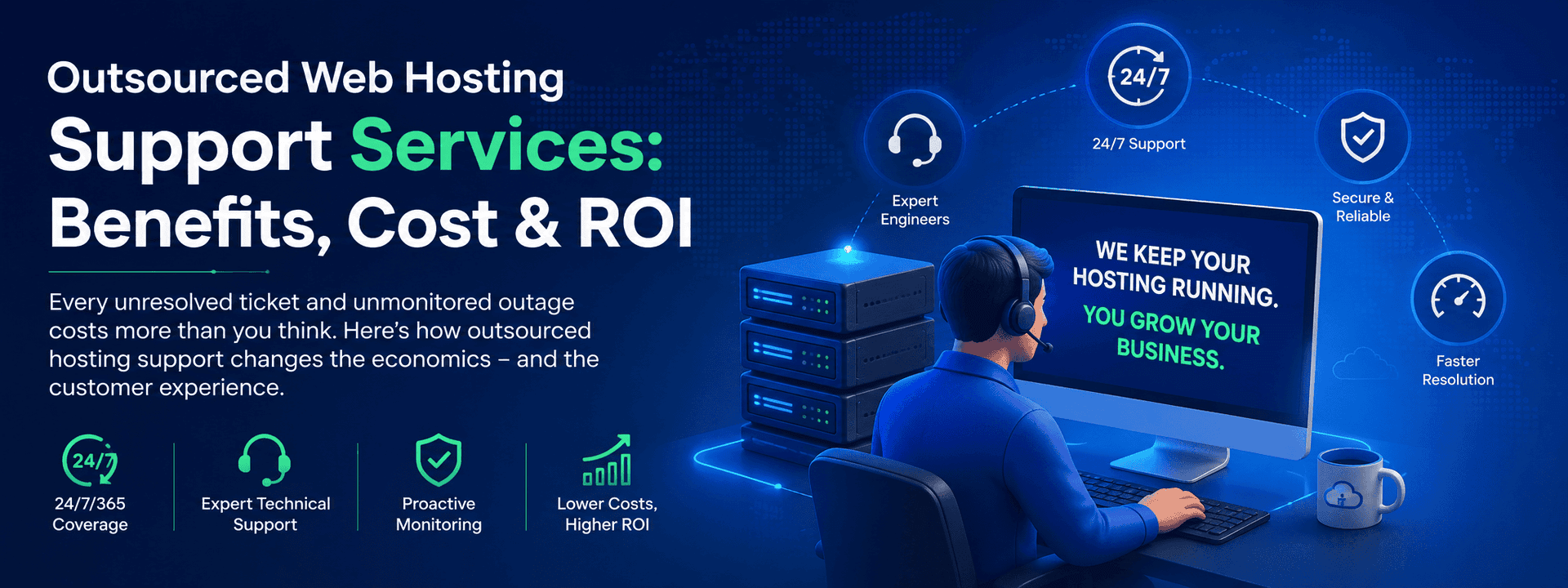
Every unresolved ticket and unmonitored outage costs more than you think. Here's how outsourced hosting support changes the economics - and the customer experience.
Introduction
Every minute of downtime, every delayed ticket, and every missed SLA chips away at something harder to rebuild than infrastructure: customer trust. As hosting companies scale, maintaining a highly skilled in-house support team becomes increasingly expensive, operationally fragile, and difficult to sustain around the clock.
Outsourced web hosting support enables businesses to deliver uninterrupted 24/7 technical assistance - without the overhead of recruiting, training, and managing a rotating shift workforce. When done right, it reduces operational costs while measurably improving resolution times, customer satisfaction, and long-term retention.
This guide covers what outsourced hosting support actually includes, the eight business benefits that drive real ROI, and the signals that tell you it's time to make the switch.
What Is Outsourced Web Hosting Support?
https://www.supportsages.com/blog/what-is-outsourced-web-hosting-support
Outsourced web hosting support is a model where a hosting company partners with a specialist provider to handle technical operations on their behalf - typically under a white-label arrangement, so end customers see only the hosting brand. The scope can range from frontline ticket handling to deep server administration and 24/7 infrastructure monitoring.
Technical Support
Handling end-user queries, troubleshooting, and L1-L3 escalation across all ticket channels.
Server Administration
Routine maintenance, security patching, performance optimisation, and configuration management.
White-Label Support
Seamless service delivered entirely under your brand - helpdesk, email signatures, SOPs, all yours.
Infrastructure Monitoring
Proactive 24/7 tracking to identify and resolve issues before they trigger customer-facing outages.
Key distinction: White-label outsourced support means your customers never know a third party is involved. The outsourced team operates inside your helpdesk, uses your brand voice, and follows your established SOPs - functioning as a seamless extension of your internal team.
Why More Hosting Companies Are Outsourcing Support
The economics of hosting have shifted. Margins on shared and VPS plans have compressed, customer expectations for response times have accelerated, and the technical complexity of modern infrastructure - spanning cloud environments, container orchestration, and edge configurations - has outpaced what generalist in-house teams can cost-effectively cover.
At the same time, the risk profile of support has changed. Your support team is the operational face of your company. The quality of your outsourced partner directly dictates customer retention rates and brand reputation. Consistently missing SLAs or delivering inconsistent technical responses drives customers to competitors - and in a market where switching costs are low, that churn compounds fast.
Outsourcing has evolved from a cost-cutting tactic into a genuine strategic lever: a way to field a deeper, more specialised team than headcount would otherwise allow, without the operational fragility of building and retaining that team yourself.
8 Business Benefits of Outsourced Hosting Support
1. Lower Operational Costs
Building an internal 24/7 support team requires substantial upfront and ongoing capital: recruitment fees, continuous technical training, shift allowances for night and weekend staff, benefits packages, and management overhead. Outsourcing converts this unpredictable cost structure into a single, predictable monthly engagement - dramatically reducing financial exposure while maintaining or improving service standards. For most hosting companies, the savings versus equivalent in-house capability run between 40-60%.
2. 24×7 Technical Coverage
Downtime doesn't respect business hours. A server failure at 2 AM on a public holiday carries exactly the same customer impact as one during peak daytime traffic. Outsourced teams provide genuine 24/7/365 coverage - fully staffed night shifts, weekend engineers, and holiday cover - ensuring your global customer base is supported across every time zone without the staffing complexity of building that rotation internally.
3. Faster Ticket Resolution
A dedicated support partner dramatically reduces Mean Time To Resolution (MTTR). By routing tickets through a structured tiered system - L1 for frontline issues, L2 for deeper server investigations, L3 for complex infrastructure failures - every ticket reaches the right engineer immediately rather than sitting in a queue waiting for the one person with the relevant expertise. This structure also enables strict SLA adherence that would be difficult to maintain with a flat in-house team.
4. Access to Specialized Expertise
Modern hosting infrastructure is technically demanding. A quality outsourced partner gives you immediate access to engineers with deep experience across cPanel and Plesk administration, Nginx and LiteSpeed configuration, CloudLinux management, and complex cloud ecosystems including AWS, Google Cloud, and Azure. Hiring and retaining this breadth of expertise in-house - particularly at L2 and L3 level - is expensive and increasingly difficult in a competitive talent market.
5. Better Customer Retention
Fast, accurate, empathetic responses define the customer experience more than any feature or price point. When technical issues are resolved on first contact, without unnecessary back-and-forth, customer frustration drops and brand loyalty rises. In a subscription model, even a 5% improvement in annual retention rate compounds significantly across a customer base - making support quality one of the highest-leverage levers in your entire revenue operation.
6. Improved Business Scalability
Whether you're running a campaign that triples inbound ticket volume or onboarding a new enterprise client with complex infrastructure requirements, an outsourced team scales with you immediately. You never have to pause growth because support capacity can't absorb it. Equally, during quieter periods you're not carrying the fixed cost of overstaffed in-house teams - the model flexes in both directions.
7. Reduced Management Overhead
Managing a 24/7 technical team is itself a full-time job. Shift scheduling, sick leave cover, recruitment pipelines, ongoing training programmes, performance management, and knowledge base maintenance all consume leadership time that could be directed at product, sales, or infrastructure strategy. Outsourcing transfers this operational burden to the partner, with a Technical Account Manager and regular review cadence keeping you fully informed without requiring daily involvement.
8. Better ROI Than Building an Internal Team
When you calculate the true Total Cost of Ownership (TCO) of an in-house team - including recruitment, salaries, training, tooling, management, attrition costs, and the revenue impact of the gaps when engineers leave - outsourced support consistently delivers superior ROI. It transforms support from a cost centre that grows linearly with your customer base into a fixed operational investment that scales efficiently and delivers measurable impact on customer lifetime value.

Real Cost Comparison
Table:
Cost Factor | In-house Team | Outsourced Support |
| Recruitment | High - time and agency fees per hire | Included in engagement |
| Ongoing Training | Continuous expense; your responsibility | Included - provider responsibility |
| 24×7 Coverage | Requires 4-5 FTEs minimum for rotation | Fully covered at fixed monthly cost |
| L3 Infrastructure Expertise | Expensive to hire; hard to retain | Available on demand as standard |
| Staff Replacement / Attrition | Disruptive, costly, and time-consuming | No operational impact - handled internally |
| Management Overhead | High - scheduling, HR, performance | Minimal - TAM + regular reporting cadence |
When Should You Consider Outsourcing?
It may be time to evaluate an outsourced partner if you are experiencing:
- Steadily growing ticket volumes that outpace your staff.
- Noticeably delayed response and resolution times.
- Burned-out engineers handling repetitive L1 tasks.
- An expanding customer base pushing into new time zones.
- Difficulty sourcing and hiring experienced server administrators.
Why SupportSages?
At SupportSages, we don't just answer tickets - we manage infrastructure. Our team of seasoned L1, L2, and L3 engineers delivers seamless white-label support built around your brand, your helpdesk, and your SOPs.
Our ISO 27001-certified processes ensure security at every level of the engagement. Weekly operational review meetings provide full transparency on SLA compliance, ticket trends, and infrastructure health. And from traditional server management to complex cloud support across AWS, GCP, and Azure, we provide the 24/7 coverage your hosting business needs to scale with confidence.
Every engagement includes a dedicated Technical Account Manager, proactive monitoring with early-warning alerting, and root-cause analysis documentation following any major incident - so you're always informed, never surprised.
Outsourced Support as a Strategic Investment
As customer expectations continue to rise, hosting companies need more than just reliable infrastructure they need reliable support operations that can scale with their business. Outsourced web hosting support enables providers to improve service quality, extend 24/7 coverage, reduce operational complexity, and give internal teams the freedom to focus on growth rather than day-to-day support management.
The value of outsourcing is measured not only in cost savings but also in faster response times, stronger customer retention, improved SLA performance, and greater operational resilience. For growing hosting businesses, the question is no longer whether outsourced support can reduce costs, but whether an in-house model can continue to deliver the same level of efficiency, expertise, and scalability as customer demands evolve.