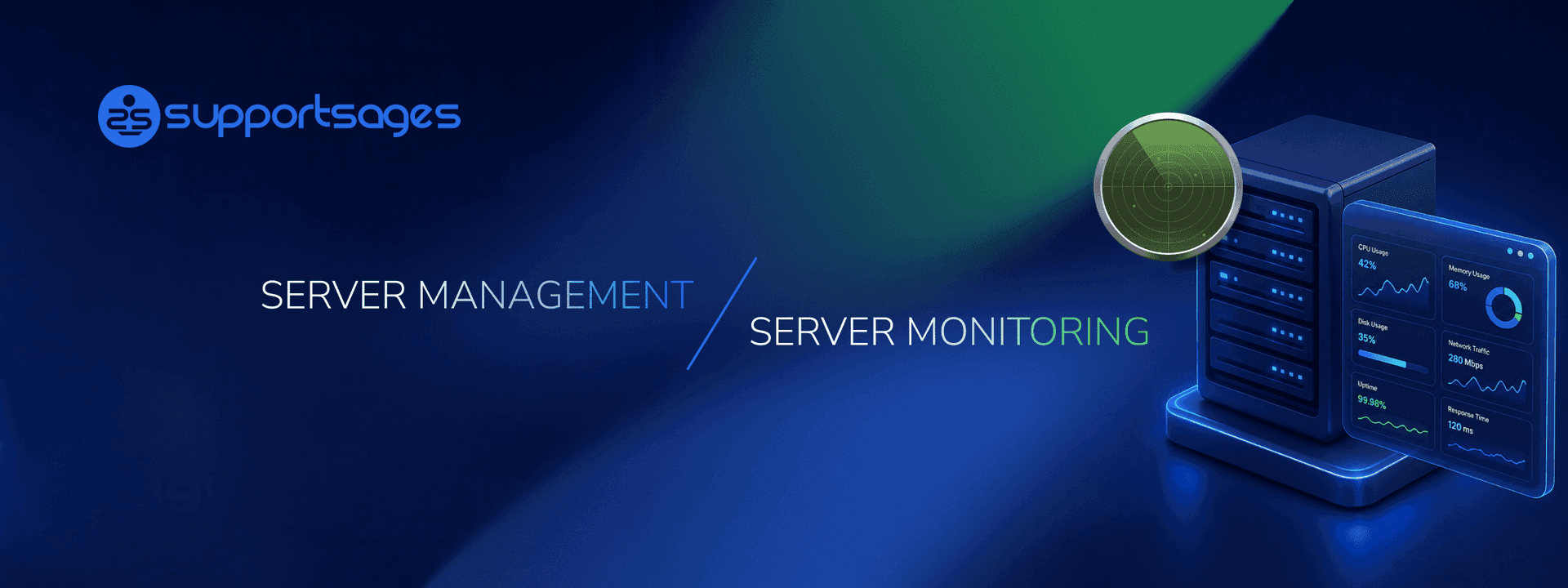
Server monitoring tracks your server's health in real time and alerts you when something goes wrong. Server management is the hands-on expertise that actually fixes the problem, keeps your server secure, and optimizes performance around the clock. Businesses need both - monitoring without management means you'll know your site is down but have no one ready to bring it back up.
For companies running websites, SaaS platforms, or eCommerce stores, understanding this difference is critical. Choosing the wrong level of server support leads to preventable downtime, lost revenue, and eroded customer trust. Here's what separates the two - and why the best hosting strategy combines them.
What is Server Monitoring?
Server monitoring is the continuous, real-time process of tracking your server's health, performance, and availability. Dedicated monitoring tools run 24/7, collecting data across key system metrics and triggering instant alerts the moment a predefined threshold is crossed or a critical service goes down.
Common metrics tracked by server monitoring include:
- CPU usage
- Memory (RAM) utilization
- Disk space availability
- Network traffic and bandwidth
- Website uptime and response time
- Database performance and query load
- Critical service status (web server, mail server, SSH, etc.)
For example, if disk usage climbs to 95%, a web service stops responding, or database query times spike unexpectedly, the monitoring system flags it immediately and notifies your server administrators - often before end users even notice a problem.
Benefits of Server Monitoring
Investing in dedicated server monitoring delivers measurable advantages for any business running mission-critical hosting infrastructure:
- Early detection of performance issues - Catch CPU spikes, memory leaks, and disk pressure before they escalate into outages
- Reduced downtime through real-time alerts - Instant notifications mean your support team responds in minutes, not hours
- Improved visibility into server health - A clear, continuous picture of your infrastructure eliminates guesswork
- Better capacity planning and resource allocation - Historical performance data helps you scale proactively rather than reactively
That said, monitoring has one fundamental limitation: it tells you something is wrong, but it cannot fix it. For that, you need server management.
What is Server Management?
Server management is the ongoing, hands-on administration of your hosting infrastructure - covering everything from routine maintenance and security patching to performance tuning and emergency incident response. It is the human expertise layer that turns monitoring alerts into resolved problems and keeps your servers running securely and efficiently around the clock.
Security Management
Security threats don't follow business hours, and neither should your server protection. A managed server support team handles:
- Operating system updates and kernel patching
- Timely security patching across all installed software
- Firewall configuration and rule management
- Malware detection, quarantine, and removal
- Server hardening to reduce your attack surface
Performance Optimization
A slow server costs you customers. Server management keeps your infrastructure performing at its best through:
- Web server tuning (Apache, Nginx, LiteSpeed)
- Database optimization and query performance improvements
- Resource allocation and load balancing
- Proactive troubleshooting of performance bottlenecks before they impact users
Backup & Recovery
Data loss can be catastrophic. Managed server support ensures your backup strategy is airtight:
- Backup configuration tailored to your business needs
- Ongoing backup monitoring to verify successful completion
- Disaster recovery planning for worst-case scenarios
- Fast, reliable data restoration support when you need it most
Incident Resolution
When your monitoring system fires an alert, server management takes over. Your dedicated administrators investigate the root cause, apply the fix, and restore normal operation - minimizing downtime and keeping your business running. This is the critical gap that monitoring alone simply cannot fill.
Server Management vs Server Monitoring
The simplest way to understand the difference:
Server Monitoring tells you something is wrong. Server Management fixes it.
But the distinction goes deeper than that. Monitoring is passive by nature - it watches, measures, and alerts. Server management is active - it investigates, resolves, secures, and optimizes. One without the other leaves a critical gap in your hosting support coverage.
Feature | Server Monitoring | Server Management |
| Detects Issues | Yes | Yes |
| Sends Alerts | Yes | Sometimes |
| Applies Security Updates | No | Yes |
| Troubleshoots Problems | No | Yes |
| Optimizes Performance | No | Yes |
| Manages Backups | No | Yes |
| Resolves Outages | No | Yes |
Monitoring is reactive, while management is proactive.

Why Businesses Need Both
One of the most common - and expensive - misconceptions in the hosting industry is assuming that server monitoring means your server is fully managed. Most standard hosting providers only guarantee infrastructure uptime. What happens on your server is largely your responsibility.
Businesses that combine server monitoring with proactive server management gain a significant operational advantage:
- Faster issue detection - Problems are caught at the metric level, before users report them
- Reduced downtime - Alerts trigger immediate human response, not just inbox notifications
- Improved website performance - Ongoing tuning keeps your server running at peak efficiency
- Enhanced security - Patches, firewall rules, and hardening happen continuously, not reactively
- Proactive maintenance - Issues are prevented, not just resolved
- Greater operational reliability - Your infrastructure is managed like a business-critical asset, because it is one
For mission-critical websites, eCommerce platforms, and SaaS applications, relying on monitoring alone isn't a cost-saving measure - it's a risk you're carrying silently until something breaks.
A Real-World Example
Picture a mid-sized eCommerce store running a flash sale. Traffic surges within minutes of the promotion going live.
The monitoring system immediately detects:
- CPU utilization climbing past safe thresholds
- Database response times slowing under concurrent query load
- Overall website performance degrading in real time
An alert fires instantly.
Now here's where the two services diverge. With monitoring alone, your team receives a notification - and then scrambles to figure out what to do next. With a managed server support team already in place, the response is immediate and structured:
- Root cause is identified within minutes
- Server resources are dynamically optimized for the traffic spike
- Web server configurations are adjusted to handle concurrent connections
- Database queries are tuned for performance under load
- The site stays live, the sale continues, and revenue is protected
The difference isn't just technical - it's financial.
Choosing the Right Hosting Support
Not all hosting support is created equal. If your business depends on its online presence - whether that's an eCommerce store, a client-facing application, or a content platform - the level of server support you choose directly impacts your bottom line.
When evaluating managed hosting support providers, look for these non-negotiables:
- 24/7 server monitoring with real-time alerting
- Proactive server management - not just break-fix response
- Security patching and server hardening on a defined schedule
- Performance optimization as an ongoing service, not a one-time setup
- Backup management and disaster recovery planning
- Incident response and troubleshooting with guaranteed response times
Avoid providers who only offer monitoring under the label of "managed hosting." Ask specifically: who responds when an alert fires, and what do they do? The answer tells you everything.
Conclusion
Server monitoring and server management are not interchangeable, but they are inseparable for any business that takes uptime seriously. Monitoring gives you visibility into what's happening on your server. Management gives you the expertise to act on it — resolving issues, hardening security, optimizing performance, and preventing problems before they impact your customers.
At SupportSages, we deliver both. Our 24/7 server monitoring keeps a constant watch on your infrastructure, while our proactive server management team ensures every alert is met with immediate, expert action, not just a notification in your inbox.
Don't wait for downtime to expose the gaps in your hosting support.