

• TechOps

    Need clarity?
    Chat with our experts now

    • Web Hosting SupportWeb Hosting Support
    • Helpdesk Support

      Skilled and professional 24/7 helpdesk support

    • Product Support

      Boost your product support with our expertise

    • Managed ServicesManaged Services
    • Server Management

      Don't let server issues slow you down. Let us manage them for you

    • Server Monitoring

      Safeguard your server health with our comprehensive monitoring solutions

    • Staff AugmentationStaff Augmentation
    • Hire an Admin

      Transform your business operations with our expert administrative support

    • Hire a Team

      Augment your workforce with highly skilled professional from our diverse talent pool

  • CloudOps

    Confused?
    Discuss with our sales team now.

    • Author ProfileAWS
      Well Architected Review
    • Author ProfileFinOps As a Service

      FinOps As a Service

    • Migrate

      Upgrade the journey: Migrate & Modernize seamlessly

    • Modernize

      Effortless CloudOps mastery for seamless cloud management

    • Optimize

      Efficient CloudOps: Boosting performance through optimization

    • Manage

      Simplify compliance complexities with our dedicated service

  • DevOps

    How Supportsages
    is creating an
    impact?

    View Casestudies
    • Author Profile24/7 DevOps As a Service

      Round-the-clock DevOps for uninterrupted efficiency

    • Author ProfileCI/CD Pipeline

      Automated CI/CD pipeline for seamless deployments

    • Author ProfileInfrastructure As a Code

      Crafting infrastructure with ingenious code

    • Author ProfileDevSecOps

      Integrated security in continuous DevOps practices

    • Author ProfileHire DevOps Engineers

      Level up your team with DevOps visionaries

    • Author ProfileConsulting Services

      Navigate success with expert DevOps consulting

  • SecOps

    Expert SecOps Services
    for any Scale

    • Author ProfileVAPT

      Vulnerability Assessment and Penetration Testing

    • Author ProfileSource Code Review

      Ensuring source code security and safe practices to reduce risks

    • Author ProfileSecurity Consultation

      On demand services for improving server security

    • Author ProfileSystem Hardening

      Reduced vulnerability and proactive protection

    • Author ProfileManaged SOC

      Monitors and maintains system security. Quick response on incidents

    • Author ProfileCompliance as a Service

      Regulatory compliance, reduced risk

  • Insights

    Explore our latest
    insights and resources

    Blog

    Explore our latest articles and insights

    Case Studies

    Read about our client success stories

  • Contact Us

  • About
  • Certifications
  • Life at Supportsages
  • Events
  • Contact
  • Careers
  • Blog

  • Dedicated Support Team
  • Quasi-dedicated Support Team
  • Hire a DevOps Engineer
  • Hire a Billing Support Staff
  • Per-ticket Support Plan
  • Managed Services

  • Microsoft Azure Expert
  • AWS Cloud Expert
  • Hire a developer
SS

SupportSages

Bites of wisdom @ work


Copyright © 2008 - 2026 SupportSages Pvt Ltd. All Rights Reserved.
Privacy PolicyLegal TermsData ProtectionCookie Policy

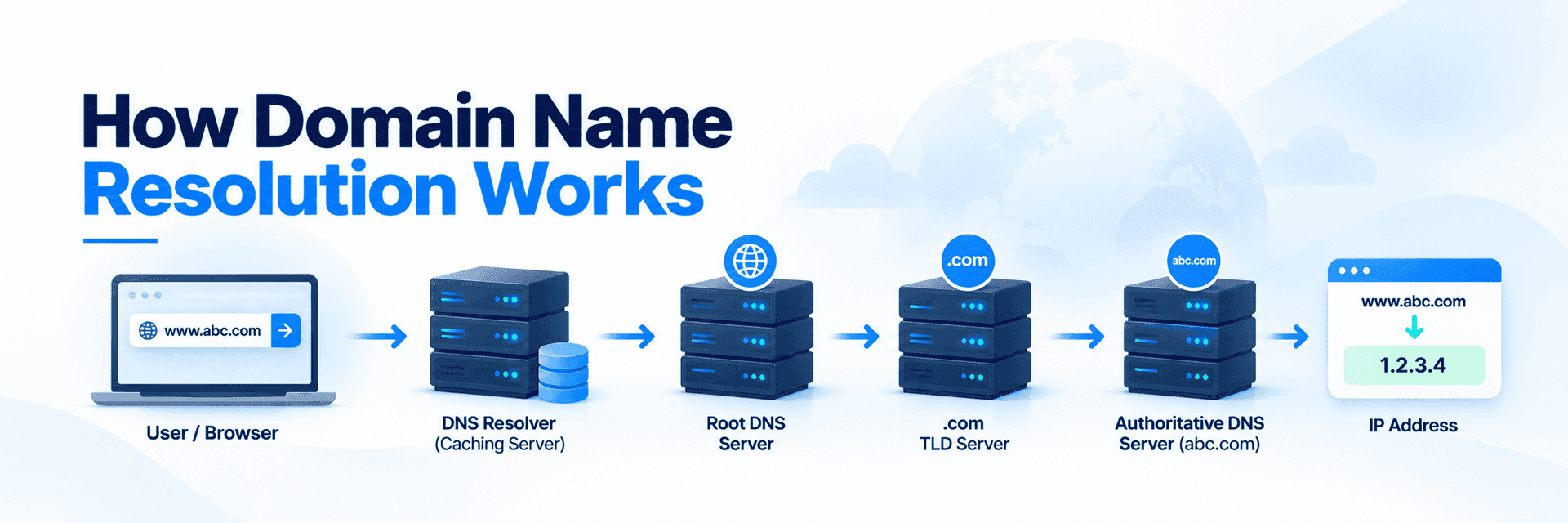
The domain name to IP resolution process – Part II/IV – DOMAIN NAMES

Abhilash Padmanabhan

  • 4 min read
SupportSages Logo

Generating audio, please wait...

Before I go on to the query process, I would like to present a small briefing about Domain Names basics :

The Domain Name System uses a tree (or hierarchical) name structure. At the top of the tree is the root node followed by the Top-Level Domains (TLDs), then the Second-Level Domains (SLD) and any number of lower levels, each separated with a dot. TLDs are split into two types:

1. Generic Top-Level Domains (gTLD): For example, .com, .edu, .net, .org, .mil, etc.

2. Country Code Top-Level Domains (ccTLD): For example, .us, .ca, .tv, .uk, etc.

For instance abc.com, is actually a combination of an SLD name and a TLD name and is written from left to right with the lowest level in the hierarchy on the left and the highest level on the right:

sld.tld

The term Second-Level Domain is technically precise in that it defines nodes at the second level within the domain name hierarchy. There are also Third-Level Domains, which are especially relevant with ccTLDS. Any name just which is to exist in the Internet’s name space just to the left of the gTLD or ccTLD ( i.e. SLD ) should be brought from an Accredited Registrar or simply, Registrar.

So what is www.abc.com?

From our reading previously on domain names basics, we can see that if we assume a domain name www.abc.com, is built up from www and abc.com. The domain name abc.com part was delegated from a gTLD registrar, which in turn was delegated from ICANN. The owner of the domain chose the www part since they are now the delegated authority for the abc.com domain name. They own everything to the left of the delegated domain name, in this case abc.com *. The leftmost part, the www in this case, is called a host name. Keep in mind that only by convention do web sites use the host name www (for World Wide Web), but a web site can be named efg.abc.com—few may think of typing this into their web browser, but that does not invalidate the name! Every computer that is connected to the Internet or an internal network and is accessed using a name server has a host name.

Consider some examples:

www.abc.com  a company web server

ftp.abc.com  a company file transfer protocol server

pc17.abc.com  a normal PC

A host name must be unique within the delegated domain name, but can be anything the owner of abc.com wants. Say, he can make ftp.abc.com as the web server. There is no protocol or convention to name web servers starting with www. It is usually given for better understanding that the name starting with www will be the web server and that starting with ftp will be the ftp server.

One more thing to note is that q1.abc.com & q2.abc.com need not be 2 different hosts (separate machines). It can also be 2 different sub-domains of abc.com on the same host!

To summarize: the owner can delegate, in any way they want, anything to the left of the domain name they own (or were delegated). The delegated owner is also responsible for administering this delegation.

* For .name TLD, the registry handling it, Verisign Inc., places some restrictions regarding the registration of third level domain names and it’s ownership. You may find further details on it at :

http://www.verisign.com/domain-name-services/domain-information-center/name-faq/index.html


  • Linux
  • Training

Looking for AWS Experts?

We provide top-of-the-line custom AWS setup services tailored to your needs.

The domain name to IP resolution process – Part II/IV – DOMAIN NAMES

500 Internal Server due to low RLimitMem value

SupportSages Logo
  • Apache
  • cPanel
  • General
  • Linux
logo

Change all user account passwords in a cPanel server

Change all user account passwords in a cPanel server
  • cPanel
  • Linux
  • Snippets
logo

cPanel, postgresql and a default database issue with 8.4.x versions of postgres

SupportSages Logo
  • cPanel
  • PostgreSQL
  • Troubleshooting
logo

CRITICAL : Serious kernel bug!!! Root privilege escalation

SupportSages Logo
  • Linux
  • VPS
logo

Posts by Abhilash Padmanabhan

Technology always fascinated me and continues to do so. I started my career back in 2004 as a Junior System Admin and worked in various capacities both in technical and managerial roles. I love to experiment and try out new OSS projects and in free time, go for cycling to the interiors of God's own country, Kerala!