
Our Leadership team is attending CloudFest 2026, from Mar 22 - April 8. Schedule a Connect

Our Leadership team is attending CloudFest 2026, from Mar 22 - April 8.

Discuss MSP growth, DevOps excellence, and Cloud Transformation. Available for 1:1 meetings, Schedule a Connect

  • DevOps
    Case Study

    How we helped a development company rebuild DevOps for efficiency and scale.

    READ CASESTUDY
    icon

    24/7 DevOps as a Service

    Round-the-clock DevOps for uninterrupted efficiency.

    icon

    Infrastructure as a Code

    Crafting infrastructure with ingenious code.

    icon

    CI/CD Pipeline

    Automated CI/CD pipeline for seamless deployments.

    icon

    DevSecOps

    Integrated security in continuous DevOps practices.

    icon

    Hire DevOps Engineers

    Level up your team with DevOps visionaries.

    icon

    Consulting Services

    Navigate success with expert DevOps consulting.

  • TechOps
    Case Study

    How a US hosting leader scaled with us!

    READ CASESTUDY

    WEB HOSTING SUPPORT

    icon

    HelpDesk Support

    Highly skilled 24/7 HelpDesk Support

    icon

    Product Support

    Boost your product support with our expertise.

    MANAGED SERVICES

    icon

    Server Management

    Don’t let server issues slow you down. Let us manage them for you.

    icon

    Server Monitoring

    Safeguard your server health with our comprehensive monitoring solutions.

    STAFF AUGMENTATION

    icon

    Hire an Admin

    Transform your business operations with our expert administrative support.

    icon

    Hire a Team

    Augment your workforce with highly skilled professionals from our diverse talent pool.

  • CloudOps
    Case Study

    How we helped a Private Deemed University in India, save US $3500/m on hosting charges!

    READ CASESTUDY
    icon

    AWS Well Architected Review

    Round-the-clock for uninterrupted efficiency

    icon

    Optimize

    Efficient CloudOps mastery for seamless cloud management

    icon

    Manage

    Automated CI/CD pipeline for seamless deployments

    icon

    Migrate

    Upgrade the journey, Migrate & Modernize seamlessly

    icon

    Modernize

    Simplify compliance complexities with our dedicated services

    icon

    FinOps as a Service

    FinOps as a Service

  • SecOps
    Case Study

    Enabling financial grade platforms through strategic cloud modernisation.

    READ CASESTUDY
    icon

    VAPT

    Vulnerability Assessment and Penetration Testing

    icon

    Source Code Review

    Ensuring source code security ans safe practices to reduce risks

    icon

    Security Consultation

    On demand services for improving server security

    icon

    System Hardening

    Reduced vulnerability and proactive protection

    icon

    Managed SoC

    Monitors and maintains system security. Quick response on incidents.

    icon

    Compliance as a Service

    Regulatory compliance, reduced risk

  • Insights
    Case Study

    How we helped a Private Deemed University in India, save US $3,500/m on hosting charges!

    READ CASESTUDY
    icon

    Blog

    Explore our latest articles and insights

    icon

    Case Studies

    Read about our client success stories

    icon

    Flipbook

    Explore our latest Flipbook

    icon

    Events

    Join us at upcoming events and conferences

    icon

    Webinars

    Watch our educational webinar series

  • Our Story
  • Contact Us

Interested to collaborate?

Get in touch with us!

Ready to elevate your business with certified cloud expertise? Contact us today to learn how our team can help you leverage cloud technology to drive growth, streamline operations, and enhance security.

  • AWSAWS
  • Azure CloudAzure Cloud
  • Google CloudGoogle Cloud
  • Akamai CloudAkamai Cloud
  • OVHOVH
  • Digital OceanDigital Ocean
  • HetznerHetzner
  • Managed Services Overview
  • Kubernetes Consulting
  • DevOps as a Service
  • Infrastructure Monitoring
  • Kubernetes Consultancy Services
  • K8s & Cloud native Solutions
  • 24/7 Infrastructure Monitoring
  • DevOps as a Service
  • Cloud CI/CD Solutions
  • White Labeled MSP Support
  • Our story
  • Life@SupportSages
  • Insights
  • Careers
  • Events
  • Services
  • Managed Services

aws partneraws advanced partner
LinkedInFacebookXInstagramYouTube
SupportSages

Copyright © 2008 – 2026 SupportSages Pvt Ltd. All Rights Reserved.
Privacy PolicyLegal TermsData ProtectionCookie Policy

Configure Disk Quota on Ubuntu Server

Author Profile
Anitta Jose
  • 6 min read
Configure Disk Quota on Ubuntu Server

Generating audio, please wait...

Disk quotas can be used to limit the amount of disk space or the number of files allocated to a user or members of a group. This prevents one user or group of users from consuming all of the available disk space. It is very useful in large multi-user environment.

Types of quotas

  • Usage quota or Block quota: It limits the amount of disk space that can be used.
  • File quota or Inode quota: It limits the number of files and directories that can be created.

Few basic terms related to disk quota

Soft Limit

This is a warning level where users are informed that they are nearing their limit. If they are not using grace periods, the soft limit is the maximum amount of available space for each user.

Hard Limit

This is the exact limit beyond which a user cannot use. Hard limits are necessary only when the users are using grace periods. If grace periods are enabled, this will be the absolute limit a user can use. Any attempt to consume resources beyond this limit will be denied.

Grace Period

During this period the users are allowed to temporarily violate their quotas by certain amounts if necessary. Linux has provided the default of seven days for both inodes and block usage i.e, a user may exceed the soft limit on either resource for up to seven days. After that, further requests by that user to use files will be denied.

Common disk quota utilities/Commands

  • quota – Display a user’s file system disk quota and usage
  • edquota – Edit user quotas for file system
  • repquota – Summarize quotas for a file system
  • quotaon – Turn file system quotas on and off
  • quotacheck – Scan a file system for disk usage, create, check and repair quota files
  • quotatool – Manipulate file system quotas from the command line
  • /etc/fstab – Configuration file that contains information of all the partitions and storage devices in the system
  • /etc/mtab – Lists all currently mounted file systems along with their initialization options

Configure disk quota on ubuntu

First step is the installation of quota package. Inorder to install quota, Open the terminal and type:


#apt-get install quota quotatool

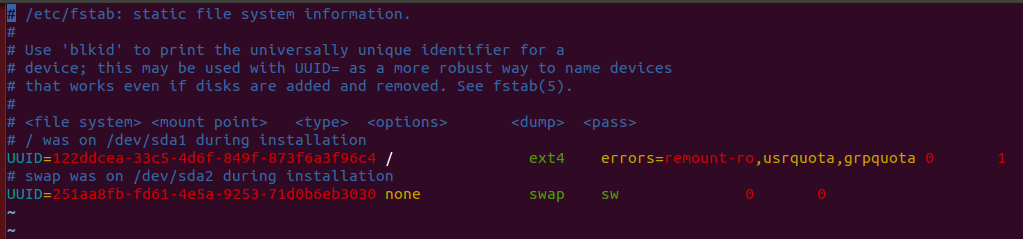
Now edit the /etc/fstab file. Add usrquota and grpquota options to the mount point, so that the kernel knows it should manage that partition using quotas.

The usrquota and grpquota options are used to enable the user quota and group quota mount option(s) on selected file systems respectively.

Open “fstab” file using your favorite text editor, here I’m using VI editor since it is my favorite:


#vi /etc/fstab

After adding the usrquota and grpquota options, fstab looks like this:
Then we need to create two files that manage the quota levels in the partition. To create, Open the terminal and type:


#touch /quota.user /quota.group

The file should be owned by root so change its permission as follows:


#chmod 600 /quota.*

To make the setting take affect, the / has to mounted using the new entries in the /etc/fstab. If you are setting up quota on a local machine, the easiest way is  rebooting the system.


#shutdown -r now

If we’re unable to reboot the system, an alternative method is to remount the partition as shown below:


#mount -o remount /

After re-booting or re-mounting the file system, the partition will show up in the list of mounted file systems as having quotas.

You can confirm the mount options by executing th command


#mount

You can get the same result by checking  /etc/mtab file


#vi /etc/mtab


Instead of checking the /etc/mtab, an alternate method is to check /proc/mounts using any of the text editors as shown below:

 #vi /proc/mounts 

Quota Activation

When each quota-enabled file system is remounted, the system is now capable of working with disk quotas. However, the file system itself is not yet ready to support quotas.

To do this, we must first run quotacheck.


#quotacheck -avug

The options and its use are given below:

a – Check all mounted non-NFS file systems in /etc/mtab

v – Display a message for each file system affected

u – Check for user disk quotas

g – Check for group disk quotas

Now run quotaon command, which announces to the system that disk quotas should be enabled on one or more file systems.


#quotaon –avug

The options used in the above command and its use is shown below:

a – Enable disk quotas on all mounted file systems in /etc/fstab

v – Display a message for each file system where quotas are turned on

u – Manipulate user quotas. This is the default.

g – Manipulate group quotas

To assign quota for particular user, Open the terminal and type:


#edquota -u madhav -f /

Now edit the default quota configuration file which is shown below:

We can confirm the change by entering the user quota command in terminal:


#quota -u madhav

In-order to view the quota summary report, use the following command:

#repquota -a

The output of the above command is as follows:

I believe this blog will help you to have a clear view about disk quota 🙂

Get 24/7 expert server management

  • Linux

“SED” Options and its usage

“SED”  Options and its usage
  • Howtos
  • Linux
logo

An Introduction to AWK

An Introduction to AWK
  • Linux
  • Training
logo

How to check whether UDP connection is open or not?

How to check whether UDP connection is open or not?
  • Linux
logo

How to Enable HTTP redirection in IIS Servers

How to Enable HTTP redirection in IIS Servers
  • IIS
logo
Configure Disk Quota on Ubuntu Server

Posts by Anitta Jose

Anitta is systems engineer since 2015 and holds broad experience in Linux, WordPress, and cPanel systems administration. Her interest lies more in Cloud technologies (AWS). From 2016, she writes blogs to share her experiences with wider audience.