


The Need for Better Infrastructure Visibility
Modern IT environments are more complex than ever. Businesses now operate across on-premises infrastructure, cloud platforms, SaaS applications, and remote endpoints, generating vast amounts of data. Every login, configuration change, application request, and network connection leaves behind a digital trail in the form of logs.
The challenge isn't collecting this data-it's making sense of it. Hidden within millions of daily log entries are the early signs of security threats and operational issues. A handful of failed login attempts, an unexpected configuration change, or unusual outbound traffic may seem insignificant on their own, but together they can indicate a much larger problem.
To gain complete visibility across today's distributed environments, organizations need more than traditional monitoring. They need a solution that can collect, analyze, and correlate events from multiple sources in real time. Security Information and Event Management (SIEM) provides that centralized visibility, helping organizations detect threats earlier and respond more effectively.
Why Traditional Monitoring Is No Longer Enough
Traditional monitoring was designed to answer a simple question: Is the system working? It focuses on server uptime, application availability, and network performance. While these metrics remain important, they provide only a partial view of what is happening across an organization's infrastructure.
Modern environments span cloud platforms, virtual machines, containers, SaaS applications, and remote devices, each generating its own logs. As a result, security events often remain isolated, making it difficult to identify threats before they escalate.
Consider a phishing attack. The email gateway may detect a suspicious attachment, the endpoint records an unusual process, the firewall logs an outbound connection, and the identity provider shows a successful login using compromised credentials. Viewed separately, these events may not trigger concern. When correlated together, they clearly indicate an attack in progress.
Organizations need a centralized view that connects events across their entire environment rather than monitoring systems in isolation. SIEM provides visibility by correlating activity from multiple sources into a single platform.
To understand how organizations achieve this level of visibility, it is important to understand what SIEM is and how it works.

What Is SIEM?
Security Information and Event Management (SIEM) is a centralized platform that collects, analyzes, and correlates security-related events from across an organization's infrastructure. Rather than reviewing logs individually, SIEM centralizes information, making it easier to detect suspicious activity and respond quickly.
The acronym itself explains its purpose:
Security - Detects threats and suspicious activity.
Information - Collects data from infrastructure, applications, cloud services, and security tools.
Event - Tracks activities such as logins, file changes, configuration updates, and network connections.
Management - Centralizes monitoring, analysis, alerting, and incident response.
For example, a financial services company may operate customer portals, databases, cloud applications, and internal systems. Instead of reviewing logs separately, SIEM continuously analyzes events across the environment. If an employee account suddenly accesses sensitive financial records outside normal working hours, followed by unusually large data downloads, SIEM correlates these activities and alerts the security team before sensitive information can be exposed.
How SIEM Processes Security Events
SIEM platforms process log data through four key stages.
Log Ingestion: Data is collected continuously from operating systems, applications, cloud platforms, network devices, identity providers, and security tools.
Normalization: Since every platform generates logs differently, SIEM converts them into a standardized format, allowing events from different sources to be analyzed together.
Correlation: Rather than evaluating events individually, SIEM identifies relationships between activities occurring across multiple systems, helping uncover suspicious patterns that traditional monitoring might miss.
Alerting and Response: When predefined rules or abnormal behavior are detected, SIEM generates alerts that enable security teams to investigate and respond quickly.
By combining these stages, SIEM transforms raw machine-generated data into actionable insights, helping organizations detect and respond to threats faster.
The effectiveness of this process becomes even clearer when applied to a real-world security scenario.
SIEM in Action: Detecting an SSH Brute-Force Attack
To understand the practical value of SIEM, consider a common SSH brute-force attack targeting a Linux server.
An attacker repeatedly attempts to gain access using different username and password combinations. The server records each failed login as a separate event. Viewed individually, these entries appear harmless and are easily overlooked.
A SIEM platform, however, analyzes these events collectively. By applying correlation rules-such as detecting multiple failed login attempts from the same IP address within a short period-it identifies the activity as a potential brute-force attack and immediately generates an alert.
This enables security teams to investigate the activity, block the offending IP address if necessary, and take corrective action before unauthorized access is achieved. By correlating related events, SIEM helps organizations detect and respond to attacks much earlier.
What Does SIEM Actually Monitor?
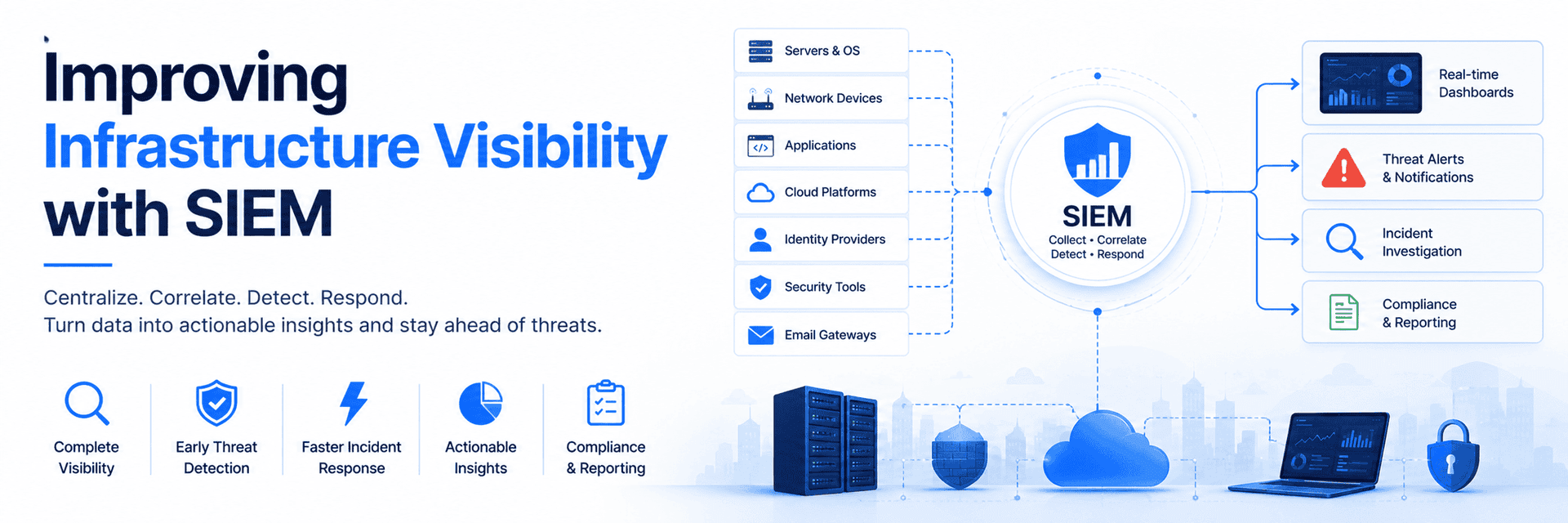
A SIEM platform collects and analyzes logs from nearly every layer of an organization's IT environment, including:
Operating Systems - Login events, account changes, privilege escalation, and process execution.
Network Devices - Firewalls, routers, switches, connection attempts, and network traffic.
Applications - Web servers, databases, ERP systems, and application logs.
Cloud Platforms - AWS CloudTrail, Microsoft Azure, and Google Cloud activity.
Identity Providers - Active Directory, Azure AD, Okta, authentication events, and MFA failures.
Security Tools - Antivirus, EDR, IDS/IPS, vulnerability scanners, and malware detections.
Email Gateways - Phishing attempts, malicious attachments, and spoofing alerts.
By correlating events across these sources, SIEM provides a unified view of the environment, helping security teams identify threats that individual systems might otherwise miss.
Effective visibility, however, depends not only on technology but also on well-defined monitoring processes.
Building an Effective Monitoring Strategy
Implementing SIEM is only the beginning. An effective monitoring strategy combines technology with well-defined processes to ensure security events are detected, investigated, and resolved efficiently.
A proactive monitoring strategy should include:
Centralized log collection across all critical infrastructure.
Real-time monitoring and alerting for high-risk events.
Correlation rules that reduce false positives while improving detection accuracy.
Continuous visibility across on-premises, cloud, and hybrid environments.
Clearly defined incident response procedures for timely and consistent action.
Regular reviews of detection rules to keep pace with infrastructure changes and emerging threats.
Together, these practices help organizations shift from reactive troubleshooting to proactive monitoring, reducing both detection and response times.
Conclusion
Modern IT environments continue to grow in size and complexity, making infrastructure visibility more important than ever. Every authentication attempt, configuration change, and network connection generates valuable information that can reveal potential issues before they become serious incidents.
SIEM transforms this data into actionable insights by collecting, correlating, and analyzing events from across the infrastructure. Rather than reacting after an incident occurs, organizations can detect suspicious activity earlier, investigate more efficiently, and respond before minor issues escalate into major disruptions.
While no technology can eliminate every security risk, a well-implemented SIEM platform provides the visibility needed to detect threats earlier, make informed decisions, and strengthen an organization's overall security posture. As organizations continue to embrace hybrid and cloud-first environments, investing in centralized visibility and proactive monitoring will be essential for maintaining secure, resilient, and reliable IT operations.