


Choosing the Right SIEM Platform
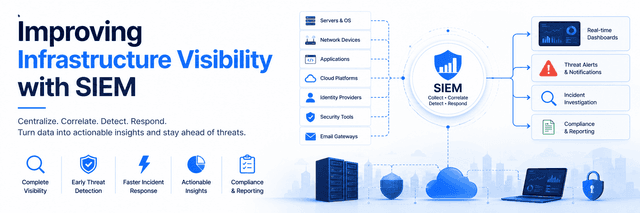
As organizations generate increasing volumes of security and operational data, selecting the right Security Information and Event Management (SIEM) platform has become more important than ever. A SIEM solution centralizes log collection, improves infrastructure visibility, accelerates threat detection, and supports faster incident response.
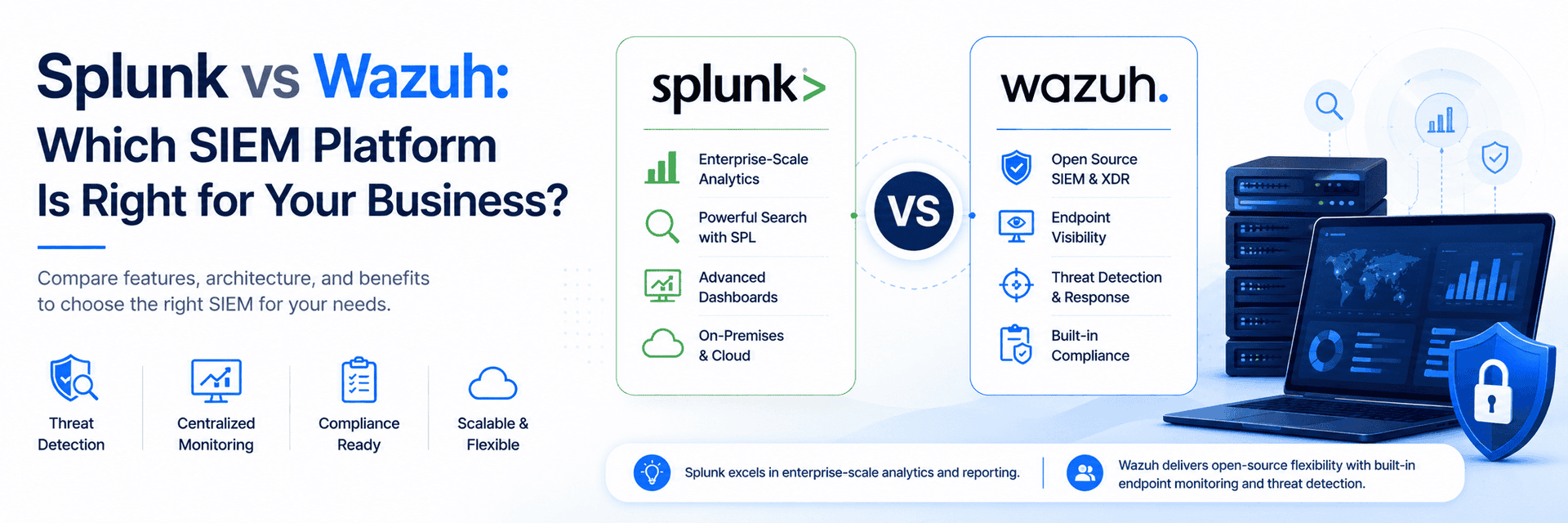
Among today's leading SIEM platforms, Splunk and Wazuh are two of the most widely adopted solutions. While both provide centralized log management and security monitoring, they serve different needs. Splunk focuses on enterprise-scale log analytics and security monitoring, whereas Wazuh emphasizes open-source flexibility, endpoint visibility, and integrated threat detection.
For example, a large enterprise processing millions of security events daily may benefit from Splunk's scalability and analytics. In contrast, a small or medium-sized organization seeking comprehensive monitoring with lower licensing costs may find Wazuh a better fit.
Understanding these differences helps organizations choose the platform that best aligns with their infrastructure, security objectives, and budget.
Splunk: Enterprise-Scale Log Analysis and Monitoring
Splunk is an enterprise platform widely used for log management, data analytics, and SIEM operations. It collects, indexes, searches, and analyzes machine-generated data from servers, applications, cloud platforms, databases, network devices, and security tools. By centralizing logs, it provides real-time visibility into operational and security events.
Its advanced analytics, dashboards, automation capabilities, and scalability make it well suited for large and complex IT environments.
Key capabilities include:
- Centralized log management
- Security monitoring and threat detection
- Infrastructure and application monitoring
- Real-time dashboards and reporting
- Compliance reporting
- Incident investigation and forensic analysis
Its ability to process large volumes of data has made Splunk one of the most widely adopted platforms for enterprise security operations.
Splunk Search Processing Language (SPL)
A key feature of Splunk is its Search Processing Language (SPL), which enables analysts to search, filter, correlate, and analyze log data using flexible queries.
Example:
index=linux sourcetype=syslog "Failed password"
| stats count by src_ip
This query groups failed SSH login attempts by source IP address, helping identify potential brute-force attacks.
SPL also enables security teams to:
- Filter events using custom criteria
- Correlate data from multiple sources
- Build dashboards and reports
- Generate automated alerts
- Support threat hunting and forensic investigations
Its flexibility helps analysts investigate incidents and extract meaningful insights from large datasets.

Wazuh: Flexible Open-Source Monitoring and Visibility
Wazuh is an open-source security platform that combines Security Information and Event Management (SIEM) with Extended Detection and Response (XDR), vulnerability assessment, file integrity monitoring, and compliance management. It collects and analyzes security events from endpoints, servers, cloud platforms, and network devices, providing centralized visibility across an organization's IT environment.
Beyond log management, Wazuh includes built-in endpoint security capabilities, making it a flexible and cost-effective solution for comprehensive security monitoring.
Key capabilities include:
- Endpoint security monitoring
- File Integrity Monitoring (FIM)
- Vulnerability assessment
- Security configuration monitoring
- Threat detection and incident response
- Compliance monitoring (PCI DSS, HIPAA, GDPR, CIS, and NIST)
Its open-source architecture allows organizations to customize detection rules and integrate with existing security tools.
Wazuh Architecture
Wazuh uses a modular architecture that simplifies security monitoring across distributed environments.
- Wazuh Agent – Collects endpoint events and forwards them to the server.
- Wazuh Server – Processes events, applies detection rules, and generates alerts.
- Indexer – Stores and indexes events for fast searching and reporting.
- Dashboard – Provides centralized monitoring and investigation.
Data Flow:
Endpoints → Wazuh Agent → Wazuh Server → Indexer → Dashboard
This architecture provides centralized visibility across the infrastructure. For example, if a Wazuh agent detects unauthorized changes to a critical system file, the event is forwarded to the server, where detection rules generate an alert for investigation through the Dashboard.
Although Splunk and Wazuh both provide comprehensive SIEM capabilities, they differ in licensing, deployment, analytics, and endpoint monitoring. The following comparison highlights their key differences to help organizations select the platform that best fits their operational and security requirements.
Splunk vs Wazuh: Side-by-Side Comparison
Feature | Splunk | Wazuh |
Licensing | Commercial | Open Source |
Primary Focus | Enterprise SIEM & Analytics | SIEM, XDR & Threat Detection |
Deployment | On-premises & Cloud | On-premises, Cloud & Hybrid |
Scalability | Enterprise-grade | Highly scalable |
Log Management | Advanced search and analytics | Comprehensive log collection |
Threat Detection | Advanced analytics and correlation | Rule-based detection with endpoint visibility |
Endpoint Monitoring | Through integrations | Built-in |
Compliance | Extensive reporting | Built-in compliance frameworks |
Best Suited For | Large enterprises | SMBs and organizations seeking open-source solutions |
Splunk is ideal for organizations requiring enterprise-scale analytics and advanced reporting. Wazuh is well suited for organizations seeking an open-source platform with integrated endpoint monitoring, threat detection, and compliance capabilities while minimizing licensing costs.
Conclusion
Splunk and Wazuh are both powerful platforms for centralized security monitoring, but they are designed to meet different operational requirements. Splunk excels in enterprise-scale analytics, advanced search capabilities, and large-scale deployments, while Wazuh offers a flexible, open-source alternative with built-in endpoint monitoring, threat detection, and compliance features.
Rather than asking which platform is better, organizations should evaluate their infrastructure, security objectives, budget, and long-term goals. Choosing the right platform improves infrastructure visibility, strengthens threat detection, and supports a more resilient security posture.