


Running a server is easy. Keeping it secure, stable, and performing well for years is the hard part.
Most businesses find that out during a traffic spike nobody was watching for, or when a routine update turns into an hour of downtime because nothing was tested first. As your website, applications, and customer base grow, the server underneath them needs regular updates, monitoring, security checks, optimization, and troubleshooting. Ignore that work long enough, and small issues start showing up as downtime, slow page loads, or security incidents your customers notice before you do.
This is the case for professional server management: not as an emergency fix, but as an ongoing practice.
What Does Server Management Include?
Server management covers the day-to-day technical work that keeps infrastructure running: monitoring and troubleshooting, OS and security patching, server hardening, performance tuning, backups, database and web server administration, and control panel work across cPanel, Plesk, or DirectAdmin.
We've covered what server management fully involves in more detail elsewhere. This post is about the concrete difference it makes to your business day to day.
Key Benefits of Server Management
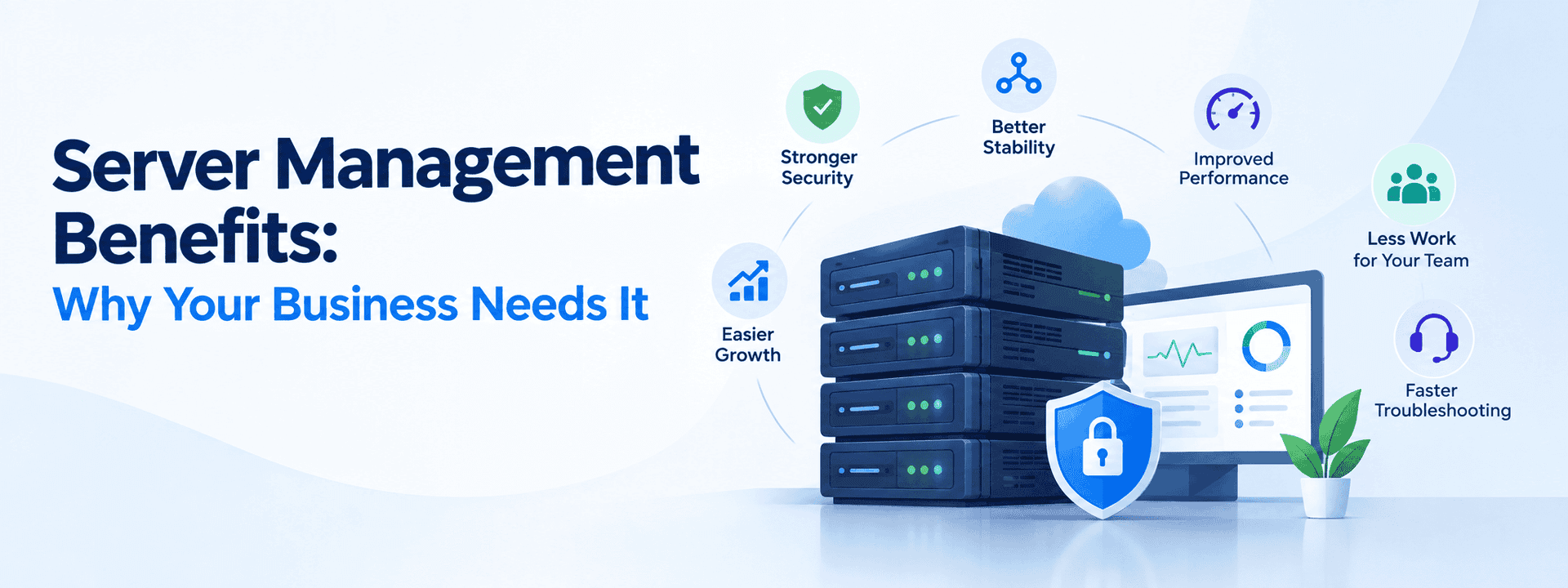
1. Better Server Stability
Regular maintenance surfaces configuration drift, resource creep, and failing services while they're still minor issues, not after they've taken something down. That's the difference between an admin fixing a slow disk on a quiet Tuesday afternoon and your team fielding angry tickets on a Saturday night.
2. Stronger Server Security
Security isn't a setting you configure once. Continuous patching, firewall management, access control, and server hardening close off the exposure that quietly accumulates on any internet-facing server over time.
3. Improved Server Performance
As traffic and workloads grow, so do bottlenecks: high CPU usage, memory pressure, disk I/O limits, slow database queries. Investigating these properly often uncovers more than a performance fix. In infrastructure reviews, we've helped clients cut AWS costs by as much as 70% simply by right-sizing resources that had quietly grown oversized. Performance and cost efficiency tend to move together.
4. Less Work for Your Internal Team
Server administration eats engineering time in small, constant increments. Handing routine administration and troubleshooting to a managed support team frees your developers and IT staff to focus on the work that actually grows the business, instead of firefighting infrastructure.
5. Faster Troubleshooting
When something breaks, experienced administrators cut down the time spent just figuring out what's wrong. A good server management team does more than restart a failed service. They investigate why it happened and put something in place so it doesn't happen again.
6. Easier Infrastructure Growth
New servers, migrations, added resources, configuration changes: all of this gets harder to manage internally as you scale. Managed server support gives you access to that expertise exactly when your infrastructure needs it, rather than after you've fallen behind.

Why Outsource Server Management?
Managing servers internally works well when you have the right skills, staffing, and 24/7 coverage in place. But building an infrastructure team just to handle server administration isn't practical for every business.
Outsourced server management gives you access to experienced administrators without building that team from scratch, and it works just as well alongside an existing IT or DevOps team, adding capacity when workload or complexity increases.
Server Management from SupportSages
SupportSages provides managed server administration for businesses that need ongoing technical support for their infrastructure, covering server monitoring, security management, performance optimization, disaster recovery, migrations, control panel administration, and VPS management.
Support is available on a per-hour, per-server, or per-admin basis, so whether you need help with a handful of servers or additional capacity for a growing environment, the plan can match how you actually operate.
Final Thoughts
Server management is not just about fixing problems after they happen. It is about maintaining your infrastructure, finding issues early, improving performance, and keeping your servers secure and reliable.
For businesses that depend on their servers every day, professional server management can reduce the operational burden while giving internal teams more time to focus on what matters to the business.
Need help managing your servers? Talk to SupportSages about your infrastructure requirements.