


A customer can't access their website. Another has an email delivery problem. A third is waiting on an update about a server issue they raised yesterday.
For a growing hosting company, tickets like these can quickly become a full-time workload of their own. The challenge isn't just solving the technical problem. It's responding quickly, communicating clearly, and keeping the support queue from spiraling while you do it.
This is where outsourced server support earns its keep.
What Is Server Support?
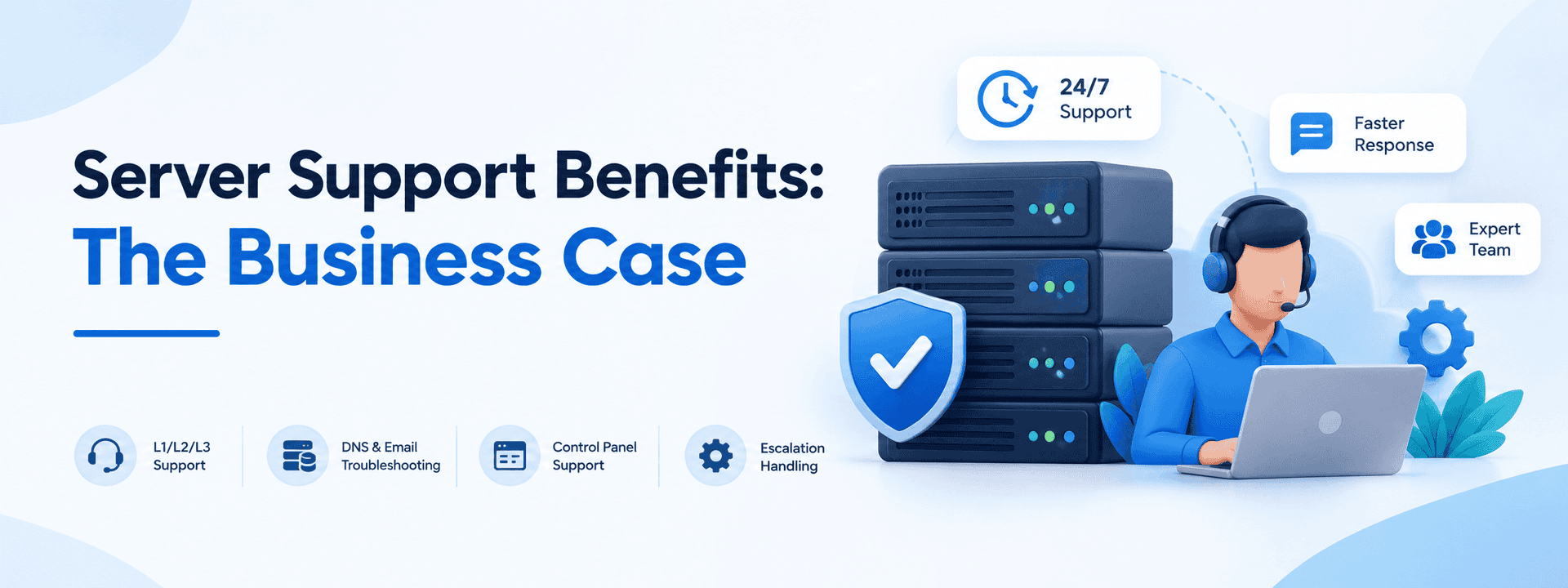
Server support covers the technical issues and customer requests tied to hosting and server infrastructure: helpdesk support, server troubleshooting, hosting support, L1/L2/L3 tiered response, escalation handling, DNS and email troubleshooting, and control panel support.
For hosting providers specifically, this isn't a back-office function. It's a core part of the customer experience.
Why It Matters
Customers rarely know what's happening behind the scenes, and they don't need to. They just expect their website, email, and applications to work, and when something breaks, they expect a fast response from someone who actually understands the problem.
A strong technical support operation meets that expectation without putting the entire workload on your internal team.

Key Benefits of Outsourced Server Support
1. 24/7 Technical Support
Server problems don't wait for office hours. Outsourced support gives you round-the-clock technical coverage, including support across time zones, without the cost and complexity of staffing your own night and weekend shifts.
2. Faster Ticket Response
As your customer base grows, ticket volume grows with it, often faster than expected. An external team adds technical capacity on demand, so the queue doesn't grow just because your customer count did. With plans starting around $20/month for a single server, that coverage doesn't require a major staffing commitment to get started.
3. The Right Expertise for Each Ticket
Not every ticket needs a senior engineer, and not every ticket should go to a junior one either. A structured L1, L2, and L3 model routes straightforward requests for quick resolution while escalating genuinely complex infrastructure problems to the people equipped to handle them.
4. A Support Experience Customers Actually Notice
Resolving a ticket is only part of the job. Customers also notice clear communication, timely updates, and someone who takes ownership of an issue instead of passing it along. A structured process is what makes that experience consistent, rather than dependent on who happens to pick up the ticket.
5. Scale Support With Your Business
Hiring a new employee every time support volume increases is not always practical. Outsourced technical support gives businesses additional capacity without requiring the same level of recruitment, training, and shift management internally.
6. Your Brand Stays Front and Center
With white-label support, your customers keep interacting with your brand while an outsourced technical team handles the work behind the scenes. Think of it as a quasi-dedicated model: a team that functions like an in-house extension without the overhead of hiring one.
7. Better Customer Experience
Good technical support is not just about resolving a ticket. Customers also expect clear communication, timely updates, proper escalation, and someone who takes ownership of the issue. A structured support process can help deliver a more consistent customer experience.
Server Support from SupportSages
SupportSages provides 24/7 outsourced and white-label technical support for hosting businesses, with L1, L2, and L3 technical support capabilities. Our team can assist with customer technical queries, server-related issues, troubleshooting, ticket handling, and escalations. SupportSages Helpdesk Support. The support model can be structured around your ticket volume, infrastructure, customer requirements, and existing technical team.
Final Thoughts
Server support is more than answering technical tickets. It helps businesses handle customer issues, extend technical coverage, reduce internal workload, and scale support as the customer base grows.
For hosting providers and businesses with customer-facing infrastructure, outsourcing server support can provide additional technical capacity without requiring the entire support operation to be built internally.
Need additional technical support for your hosting business? Talk to SupportSages about a support model built around your customers and infrastructure.