


Businesses today don't just want faster software — they want smarter, leaner, and more resilient operations. DevOps as a Service (DaaS) has emerged as the model that delivers all three, without requiring companies to build an entire in-house DevOps function from scratch.
Whether you're a growing startup navigating rapid scale or an established enterprise modernising legacy systems, DevOps as a Service offers a fundamentally different approach to how software is built, deployed, and maintained. Let's break down what your business actually gains.
63% | 40% | 3× |
01 Instant Access to Expert Talent
Hiring a full-stack DevOps engineer — let alone building a team — is expensive and time-consuming. Skilled professionals who understand CI/CD pipelines, Kubernetes orchestration, infrastructure-as-code, and security hardening are in short supply globally.
Expertise on Demand
With DevOps as a Service, you instantly tap into a bench of seasoned engineers who've solved the exact problems you're facing across dozens of environments. There's no onboarding ramp — they arrive with context, tools, and proven playbooks.
You're not just getting one DevOps hire — you're getting a collective intelligence that has operated across industries, cloud platforms, and deployment architectures. This breadth of experience is something even a well-funded internal team takes years to accumulate.
02 Significant Cost Efficiency
DevOps infrastructure - licensing, tooling, training, and ongoing maintenance — carries a hefty price tag when managed in-house. Beyond salaries, you're factoring in benefits, hardware, software licenses, and the hidden cost of context-switching when engineers wear too many hats.
Predictable, Scalable Spend
DevOps as a Service converts unpredictable capital expenditure into a manageable operational cost. You pay for what you use, scale up during peak demand, and scale down when requirements ease — without carrying the overhead of a full team year-round.
This model also eliminates the cost of downtime. Proactive monitoring, automated recovery, and around-the-clock support mean that incidents are caught and resolved before they become expensive outages.
03 Faster Time to Market
Speed is a competitive advantage. The ability to ship features, fixes, and improvements faster than your competitors is no longer a nice-to-have — it's a strategic necessity. DevOps as a Service is built around this principle.
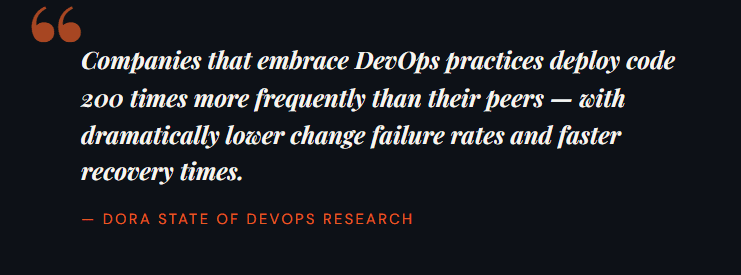
Continuous Integration and Continuous Delivery (CI/CD) pipelines are a cornerstone of any mature DevOps function. A DaaS provider will architect, implement, and maintain these pipelines so your developers can focus on writing code — not managing deployments.
Automated Pipelines, Immediate Release
Automated testing, staging environments, and one-click (or zero-click) production releases mean ideas move from a developer's laptop to your end users with minimal friction and maximum confidence.

04 Improved Reliability & Uptime
Downtime costs businesses an average of $5,600 per minute according to Gartner research. System reliability isn't just a technical concern — it's a direct line to revenue and customer trust.
DevOps as a Service providers implement Site Reliability Engineering (SRE) practices, proactive monitoring stacks, and intelligent alerting systems to ensure that issues are identified before they surface to users.
- 24/7 infrastructure monitoring with automated alerting
- Incident response playbooks and runbooks in place from day one
- Automated rollback mechanisms for failed deployments
- SLA-backed commitments and transparent uptime reporting
05 Built-In Security from the Start
Security is no longer something bolted on at the end of a development cycle. DevSecOps — the integration of security practices throughout the entire software development lifecycle — is a default expectation for any serious DevOps operation.
Security Baked Into Every Layer
A DevOps as a Service partner embeds security scanning, dependency auditing, secrets management, and compliance checks into your pipeline — so vulnerabilities are caught during development, not after a breach.
For businesses operating in regulated industries — finance, healthcare, legal, SaaS — this is especially valuable. Maintaining compliance with frameworks such as SOC 2, ISO 27001, HIPAA, or GDPR requires ongoing vigilance that a dedicated DaaS team is purpose-built to provide.
06 Elastic Scalability Without the Headache
Growth is exciting — until your infrastructure buckles under the weight of it. Whether you're preparing for a major product launch, a seasonal traffic surge, or rapid user growth, DevOps as a Service provides the architectural foundations to scale confidently.
Infrastructure-as-Code (IaC) tools like Terraform, Pulumi, or CloudFormation mean your environments can be replicated and scaled programmatically — not by manually spinning up servers in the middle of the night.
Scale Up. Scale Down. Repeat.
Auto-scaling policies, containerised workloads, and multi-region redundancy mean your platform grows with your users — and contracts intelligently when demand eases — all without firefighting or emergency spend.
07 Your Team Stays Focused
Perhaps the most underrated benefit of DevOps as a Service is the cognitive bandwidth it returns to your core team. When developers aren't troubleshooting broken pipelines, managing cloud permissions, or writing deployment scripts, they're building your product.
Engineering leaders gain the ability to set technical direction and drive innovation, rather than spending their days firefighting operational issues. Product teams move faster when the infrastructure beneath them is trustworthy and invisible — as it should be.
08 Continuous Improvement, Always
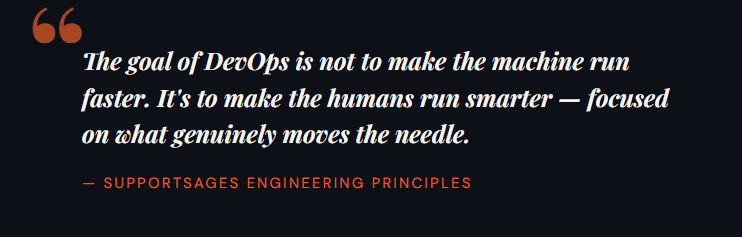
DevOps isn't a project — it's a culture of perpetual refinement. A DaaS partner brings this culture with them. Regular retrospectives, pipeline performance reviews, cost optimisation audits, and technology upgrade cycles are embedded in the engagement model.
- Regular infrastructure cost reviews and right-sizing recommendations
- Technology roadmap alignment as cloud providers evolve their services
- Performance benchmarking against industry standards and past baselines
- Knowledge transfer and documentation so your team grows alongside the platform
This ongoing partnership model means your DevOps function doesn't stagnate. You benefit from new tooling, updated best practices, and evolving security standards — without the burden of constantly retraining an internal team.