


We’ve previously discussed exactly what outsourced web hosting support is and explored the strategic benefits and ROI it brings to hosting companies, resellers, and MSPs. By outsourcing, you secure 24/7 technical coverage without the cost and complexity of recruiting, training, and retaining a full internal team.
But when it comes time to decide, one critical question usually comes first: How much does it actually cost?
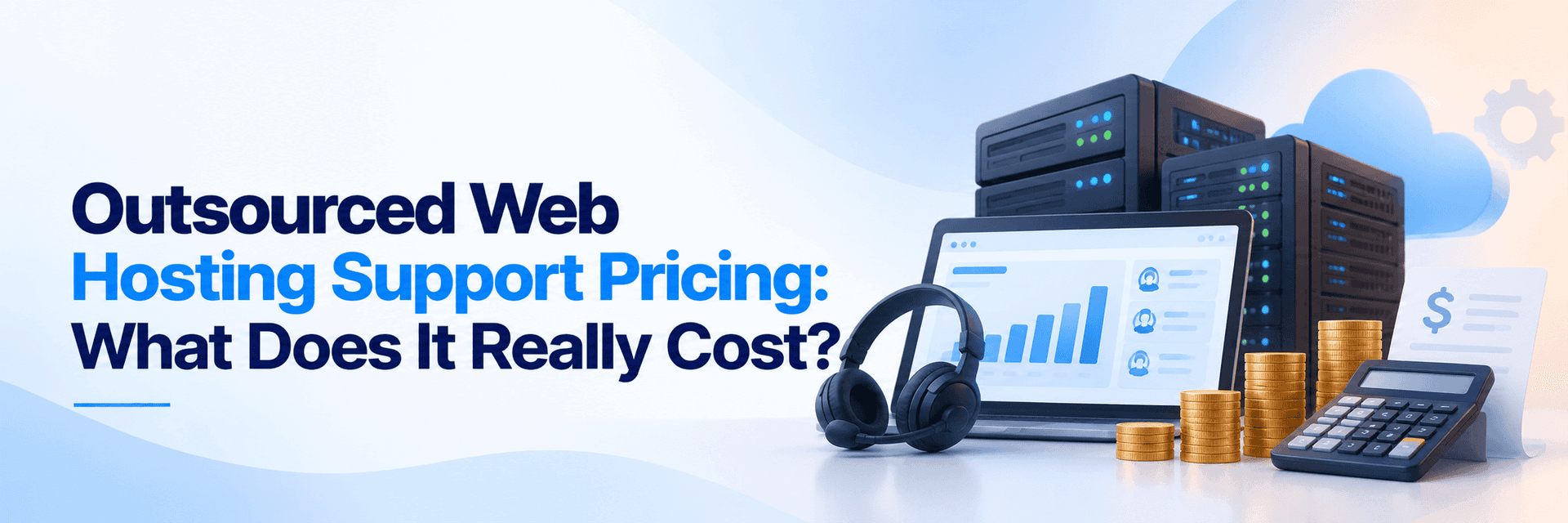
There is no single price because support requirements vary. Ticket volume, server count, support levels, coverage hours, and the type of technical work involved all affect the final cost. This guide breaks down the four main pricing models, what is included in each, and how to choose the right structure for your hosting business.
What Affects Web Hosting Support Pricing?
Before comparing pricing models, it helps to understand what you are actually paying for. While you can read our full guide on how to compare outsourced web hosting support providers, the baseline cost of your support will heavily depend on:
- Number of servers
- Monthly ticket volume
- L1, L2, or L3 support requirements
- 24/7 or business-hours coverage
- Linux or Windows environments
- Control panel expertise (cPanel, WHM, Plesk, DirectAdmin)
- Customer-facing or internal support
- White-label support requirements
- Server administration requirements
- Monitoring and escalation requirements
A business handling 50 technical tickets a month has very different requirements from a hosting provider handling hundreds of tickets every week. That is why the cheapest price per ticket does not always represent the lowest overall support cost.
In-House vs. Outsourced Cost Comparison
One of the biggest costs in technical support is the amount of time required to maintain continuous coverage.
There are 168 hours in a week, while a standard full-time employee works around 40 hours. That means 4.2 full-time employees are needed just to cover the raw hours of a continuous 24/7 rotation.
In practice, businesses also need to account for holidays, sick leave, paid time off, training, handovers, recruitment, and employee turnover. This makes true 24/7 support considerably more expensive than simply calculating one engineer's salary.
The following examples illustrate how the staffing economics can change as a hosting business grows.
Scenario 1: Startup or Small Hosting Business
Profile: 1 to 5 servers, approximately 100 tickets per month, and a requirement for round-the-clock technical coverage.
Illustrative in-house cost:
5 L1/L2 engineers × $75,000 annual CTC = $375,000/year
Outsourced example:
100 tickets × $2 = $200/month, or $2,400/year, based on the stated per-ticket rate.
The takeaway:
At low ticket volumes, hiring a complete internal team purely to provide continuous support can create a significant staffing overhead. Outsourcing allows smaller hosting businesses to access technical support without immediately building a full 24/7 team.
Scenario 2: Mid-Sized MSP or Growing Hosting Provider
Profile: 15 to 40 servers, 500 to 1,000 tickets per month, and requirements covering L1/L2 support and proactive infrastructure monitoring.
Illustrative in-house cost:
4 L2 technicians × $75,000 + 1 L3 SysAdmin × $110,000 = $410,000/year
Outsourced example:
30 servers × $70/server/month = $2,100/month, or $25,200/year, based on the stated server-based rate.
The takeaway:
For a growing hosting operation, server-based support can provide predictable monthly costs while reducing the need to build a larger internal support rotation.
Scenario 3: Enterprise Hosting Provider
Profile: 100+ servers, high ticket volumes, complex infrastructure, and requirements for L1 through L3 technical expertise.
Illustrative in-house cost:
6 L1/L2 technicians × $75,000 + 2 L3 SysAdmins × $110,000 = $670,000/year
Outsourced example:
Dedicated support team at $7,600/month = $91,200/year, based on the stated rate.
The takeaway:
For larger hosting operations, a dedicated outsourced team can provide a scalable support structure without requiring the business to recruit and manage every position internally. Based purely on these illustrative salary figures, the modeled difference is approximately $578,800 per year, before considering additional employment and operational costs.
The Four Outsourced Hosting Support Pricing Models
1. Per-Ticket Support
With a per-ticket model, you pay only for the tickets handled. This works well for businesses with low or unpredictable support volumes.
Pricing example:
Support Level | What It Covers | Price Per Ticket |
L0/L1 | Password resets, basic CMS issues, email setup | $2-$5/ticket |
L2 | Deeper investigations, root access required, migrations | $5-$10/ticket  |
L3 | Advanced operations, server optimization, forensics | $10-$25/ticket |
What's generally included:
- Pay-as-you-go billing (usually with a minimum monthly commitment of 20-50 tickets)
- SLA-backed response and resolution times
- Support across unlimited servers
Best suited for: Small hosting businesses, businesses with low or variable ticket volumes, or companies testing outsourced support for the first time.
2. Per-Server Support
With server-based pricing, you pay a fixed monthly amount based on your server count rather than ticket volume. This provides highly predictable costs for hosting businesses with a stable infrastructure, regardless of how many tickets your customers submit.
Typical Industry Pricing: Depending on whether the support is purely reactive or includes proactive management and monitoring, industry rates typically range from $30 to $100+ per server, per month.
What's generally included:
- 24/7 monitoring and support
- Unlimited tickets for the covered servers
- L1 and L2 support (L3 often available at a premium)
Best suited for: Small to mid-sized hosting companies with predictable ticket volumes, or businesses that want fixed monthly operational expenses.
3. Quasi-Dedicated Support
A middle ground between per-ticket and fully dedicated support. A shared team integrates into your infrastructure and handles both helpdesk and server management. You get the familiarity of a dedicated team but share their time (and the cost) with a few other non-competing clients.
Typical Industry Pricing: Prices generally range from $500 to $1,500 per month, depending on the allocated hours or ticket limits.
What's generally included:
- Familiarity with your specific infrastructure and custom procedures
- Consistent engineering team
- Highly cost-effective structure compared to dedicated hiring
Best suited for: Startups and growing hosting businesses that need reliable, comprehensive support without the overhead of a fully dedicated engineer.
4. Dedicated Support
A fully dedicated engineer or team works exclusively on your hosting environment. They act as a direct extension of your company, becoming intimately familiar with your infrastructure, processes, customers, and escalation requirements.
Typical Industry Pricing: Because you are essentially leasing a full-time employee, prices vary heavily based on the engineer's location (offshore vs. onshore) and expertise level. Industry averages range from $1,500 to $4,000+ per month, per engineer.
- What's generally included:
- Comprehensive L1 to L3 support
- 100% focus on your operations (no shared queues)
- Custom working hours to match your high-traffic periods
- Advanced resolution times and infrastructure management
Best suited for: Established hosting businesses with complex infrastructure, high ticket volumes, and diverse client needs across shared, reseller, VPS, cloud, and dedicated hosting.
Pricing Model Comparison at a Glance
Model | Best When | Cost Predictability | L3 Available | Ticket Limit |
Per-Ticket | Low or variable volume | Low | Yes (at premium rates) | Pay per use |
Server-Based | Stable server count | High | Often requires plan upgrade | Unlimited |
Quasi-Dedicated | Growing business, moderate volume | Medium | Yes | Limited allocation |
Dedicated | High volume, complex infrastructure | High | Yes | Unlimited |
Final Thoughts
There is no universal price for outsourced web hosting support. The right cost depends entirely on what you need your support team to handle, how many customers you support, how many servers you operate, and what level of technical expertise your business requires.
Before comparing providers, look beyond the monthly sticker price. Evaluate their SLA guarantees, their engineers' certifications, and their ability to scale. That is how you find a support model that is not just affordable, but sustainable as your hosting business grows.
Looking for the right model for your business? Talk to SupportSages today about building a custom, cost-effective support structure designed around your specific infrastructure.