


Cloud infrastructure has become an essential part of modern business operations. From customer-facing applications and databases to internal systems and business platforms, organizations increasingly depend on cloud environments to keep their operations running.
But moving workloads to the cloud is only the beginning.
As infrastructure grows, businesses have to manage servers, monitor performance, apply security updates, respond to incidents, maintain backups, control cloud spending, and ensure applications remain available.
This is where cloud management services become valuable.
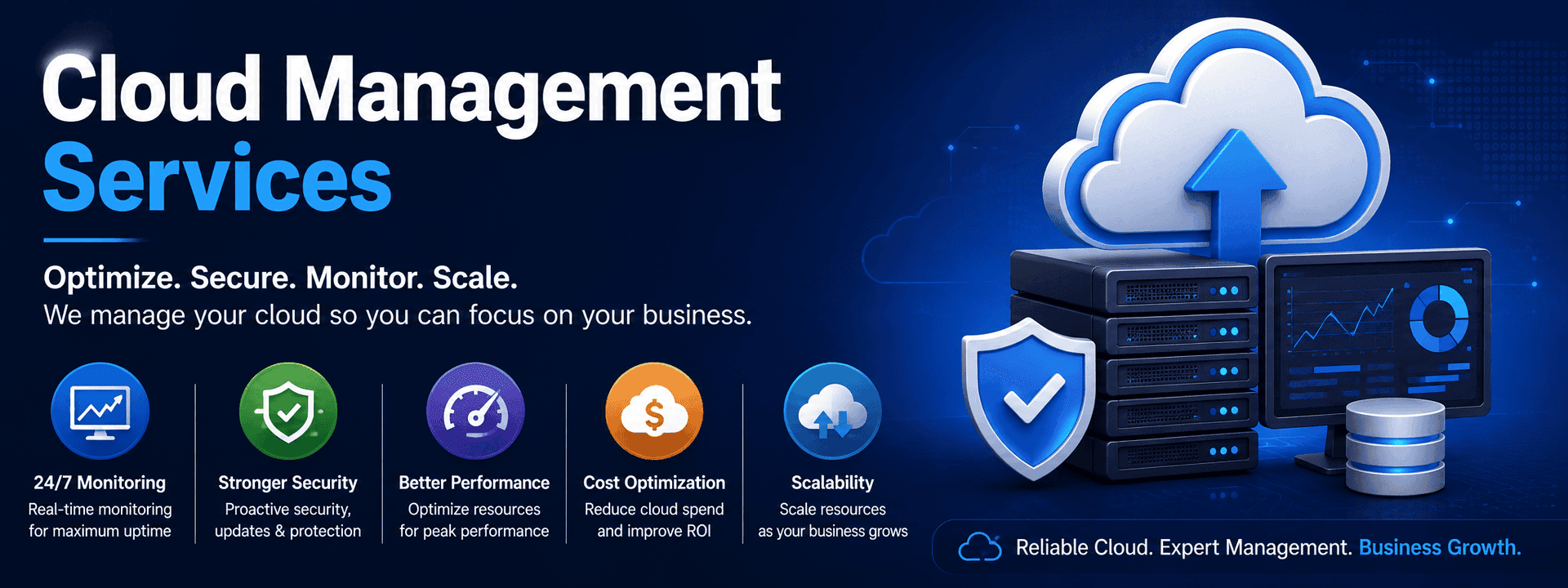
Instead of managing every aspect of cloud infrastructure internally, businesses can work with a specialized cloud management provider to handle ongoing infrastructure operations. The objective is not simply to outsource server administration. Effective cloud management helps businesses improve reliability, security, performance, operational efficiency, and ultimately the return they receive from their cloud investment.
What Are Cloud Management Services?
Cloud management services involve the ongoing monitoring, administration, optimization, and support of cloud infrastructure.
The primary objective is to keep cloud environments secure, available, optimized, and aligned with business needs. Depending on the environment and operational requirements, cloud management encompasses a broad spectrum of responsibilities. It covers cloud server management, Linux server administration, continuous infrastructure monitoring, and performance optimization. Additionally, it handles security management, backup protection, real-time incident response, capacity planning, cloud cost optimization, general infrastructure maintenance, Kubernetes orchestration, and disaster recovery support.
Why Businesses Need Cloud Management Services
Cloud platforms make it easier to provision infrastructure, but they do not eliminate the need for infrastructure management.
As environments grow, organizations often encounter increasing infrastructure complexity, rising cloud costs, performance issues, security risks, monitoring gaps, limited internal cloud expertise, and an ever-increasing operational workload.
A small infrastructure may be manageable by an internal team. However, managing production environments around the clock becomes increasingly difficult as the number of servers, applications, databases, and services increases. Cloud management services provide businesses with specialized operational support without requiring them to build a large internal cloud operations team.
24/7 Cloud Infrastructure Monitoring
Continuous monitoring is one of the most important components of cloud management. Cloud infrastructure can experience problems at any time, including outside normal business hours.
Cloud monitoring actively tracks vital system metrics like CPU utilization, memory usage, disk space, server availability, network activity, application services, database health, resource utilization, and security events. Proactive monitoring allows potential problems to be identified before they develop into major service disruptions. For businesses operating customer-facing applications, this can directly contribute to improved uptime and service reliability.
Faster Cloud Incident Response
Even well-designed infrastructure can experience incidents such as server failures, application crashes, database issues, disk exhaustion, network problems, resource spikes, or security incidents.
Without dedicated operational coverage, identifying and resolving these problems can take longer. Cloud management services provide structured incident response processes that help teams detect the issue, identify the root cause, contain the problem, restore the affected service, investigate the underlying cause, and implement preventive measures. Faster response can reduce downtime and minimize the business impact of infrastructure incidents.
Improved Cloud Security
Cloud security requires continuous attention. Security risks can emerge from outdated software, misconfigured services, weak access controls, exposed ports, vulnerable applications, poor firewall policies, or inadequate monitoring.
Cloud management services can support ongoing security operations through systematic security hardening, operating system updates, firewall management, access control reviews, security monitoring, vulnerability management, and backup protection. Security should be treated as an ongoing operational responsibility rather than a one-time configuration task.
Cloud Performance Optimization
Cloud resources need to be continuously evaluated as workloads change. A server that was appropriately sized six months ago may become overutilized, underutilized, memory constrained, storage constrained, or network limited.
Cloud management teams can analyze resource utilization and identify performance bottlenecks. Optimization involves resource right-sizing, server configuration tuning, database optimization, storage optimization, network optimization, and workload balancing. The objective is to maintain consistent performance without unnecessarily increasing infrastructure costs.
Cloud Cost Optimization
Cloud spending can become difficult to control as infrastructure expands. Common sources of unnecessary cloud costs include overprovisioned resources, idle servers, unused storage, inefficient resource allocation, and uncontrolled infrastructure growth.
Cloud management services can help organizations continuously review infrastructure utilization and identify opportunities to reduce unnecessary spending. However, cost optimization should never mean simply using fewer resources. The real objective is to achieve the right balance across:
Cost + Performance + Reliability + Scalability
Reducing infrastructure costs while causing application performance problems is not optimization. It is just moving the problem somewhere else.
Cloud Management Services Benefits
The value of managed cloud operations extends beyond infrastructure maintenance.
Reduced IT Operational Workload
Internal engineering teams often spend significant amounts of time dealing with routine infrastructure tasks like server maintenance, monitoring, troubleshooting, security updates, backup checks, and performance investigations.
Cloud management services take full responsibility for these operational activities, allowing internal teams to redirect their focus toward product development, application improvements, business projects, automation, and innovation. This significantly increases the effective productivity of existing technical teams.
Access to Specialized Cloud Expertise
Building a complete cloud operations team internally requires a wide array of specialized skill sets, including expertise in Linux administration, cloud infrastructure, networking, security, databases, monitoring, Kubernetes, and disaster recovery.
A managed cloud provider gives businesses immediate access to this broader range of operational expertise without requiring them to go through the lengthy and expensive process of hiring separate internal specialists for every single function.
Improved Infrastructure Reliability
Proactive management helps reduce the likelihood and impact of infrastructure problems. Continuous monitoring, regular maintenance, capacity planning, and incident response contribute to better uptime, faster recovery times, fewer recurring incidents, and more predictable infrastructure performance. For businesses where infrastructure availability directly affects revenue, these reliability improvements carry significant financial value.
Better Scalability
Cloud environments must evolve alongside business expansion. Managed cloud teams help organizations plan seamlessly for increased traffic, additional workloads, new applications, infrastructure expansion, high-availability requirements, and containerized workloads. This ensures that infrastructure growth never turns into an operational bottleneck.
Cloud Management Services ROI: How to Measure the Value
The ROI of cloud management services should not be measured solely by comparing the service fee with the cloud infrastructure bill. The real return comes from a combination of cost savings, productivity improvements, reduced downtime, risk reduction, and infrastructure efficiency.
1. Reduction in Cloud Infrastructure Costs
Optimization directly reduces unnecessary spending through resource right-sizing, removing unused resources, storage optimization, and continuous capacity planning. For example, if a business spends ₹5 lakh annually on cloud infrastructure and optimization reduces unnecessary spending by ₹75,000, that represents a direct infrastructure saving of ₹75,000.
2. Reduced Downtime Costs
Downtime can be significantly more expensive than the infrastructure itself. Depending on the business, an outage can result in lost sales, lost customers, SLA penalties, employee productivity loss, and lasting reputation damage. If proactive monitoring and faster incident response reduce downtime, the financial benefit can be substantial.
3. Engineering Productivity Gains
Consider an internal engineer spending 15 hours every month handling routine infrastructure tasks. If cloud management services take over this workload substantially, those hours can be redirected toward higher-value product development and innovation. The ROI therefore includes the clear financial value of engineering time recovered.
4. Reduced Hiring and Training Costs
Building a dedicated cloud operations team internally requires multiple engineers, recruitment costs, training, certifications, monitoring tools, and on-call compensation. Managed cloud services provide access to specialized expertise without requiring the business to build and maintain the entire operational function internally.
5. Improved Security and Risk Reduction
Security incidents carry severe financial and operational consequences. Cloud management services improve patch management, security monitoring, access controls, firewall configuration, and backup protection, thereby reducing the probability and potential impact of security incidents. Risk reduction may not appear directly on an invoice, but it is a major component of overall ROI.
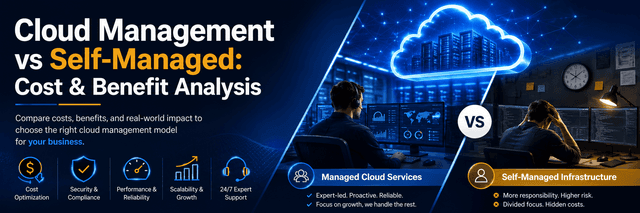
Managed Cloud Services vs In-House Cloud Management
Businesses often evaluate the trade-offs between managed cloud services and maintaining their own internal infrastructure team.
| Operational Factor | Managed Cloud Services | In-House Cloud Management |
| Team Expertise | Access to specialized cloud engineers | Requires extensive internal hiring |
| Monitoring Coverage | True 24/7 monitoring and response | Requires complex internal on-call coverage |
| Cost Predictability | Predictable monthly service costs | Fluctuating salaries and operational overhead |
| Domain Knowledge | Broad external operational expertise | Deep internal institutional knowledge |
| Skill Acquisition | Faster access to specialized skills | Skills must be built and developed internally |
| Scalability | Scales operational support on demand | Team size must scale directly with infrastructure |
Neither approach is universally better. Organizations with large, highly specialized engineering teams may prefer internal management, while businesses with smaller teams or limited cloud operations expertise benefit significantly from managed cloud services.

When Should You Consider Cloud Management Services?
Managed cloud services become particularly useful when your infrastructure is growing rapidly, your internal IT team is overloaded, or you require true 24/7 monitoring. You should also consider them if infrastructure incidents are affecting operations, cloud costs are creeping upward, security management is becoming difficult to maintain, you lack dedicated cloud operations expertise, or you simply want to focus your core engineering resources on product development. Ultimately, the decision should be guided by your overarching business requirements.
How SupportSages Helps With Cloud Management
At SupportSages, cloud management focuses on keeping infrastructure reliable, monitored, secure, and optimized after deployment or migration.
Cloud Infrastructure Management
We provide end-to-end operational muscle covering Linux server administration, cloud server management, continuous infrastructure monitoring, performance optimization, security-focused operations, and rapid incident response.
Proactive Cloud Operations
Our team handles 24/7 server monitoring, resource utilization tracking, capacity planning, proactive performance tuning, infrastructure troubleshooting, and dedicated post-migration support.
Supporting Cloud Services
SupportSages also assists businesses with cloud-to-cloud migration, Kubernetes and container support, comprehensive cloud optimization, and disaster recovery planning. This allows businesses to maintain reliable cloud infrastructure without requiring their internal teams to handle every operational task.
How to Calculate Cloud Management ROI
A practical way to evaluate ROI is to consider the total value created through managed operations using a simple framework:
Cloud Cost Savings + Downtime Avoided + Engineering Time Saved + Hiring Costs Avoided + Risk Reduction = Total Business Value
Compare that calculated value against the annual cost of the cloud management service.
For example, a business might achieve ₹1,00,000 in infrastructure savings, recover ₹1,50,000 worth of engineering productivity, avoid ₹2,00,000 in downtime impact, and eliminate ₹1,00,000 in recruitment or operational overhead. The total measurable and estimated value generated would be ₹5,50,000. If the annual managed cloud service cost is ₹3,00,000, the organization has generated significant additional operational value. While exact figures vary by business, this approach provides a far more realistic picture than comparing service fees against cloud bills alone.
Questions to Ask Before Choosing a Cloud Management Provider
Before selecting a managed cloud service provider, evaluate their technical depth and operational coverage:
1. Is true 24/7 monitoring included in the service?
2. How quickly are infrastructure alerts acknowledged and handled?
3. What is the standard protocol during a critical incident?
4. Who takes ownership of routine security updates and patching?
5. Is ongoing performance optimization included, or is it billed separately?
6. How is cloud cost optimization analyzed and executed?
7. Do you provide hands-on Linux server administration?
8. Can your engineering team support Kubernetes environments?
9. What level of reporting and monitoring visibility will our team receive?
10. Do you provide post-migration support to ensure long-term stability?
The answers will clarify whether the provider offers genuine, proactive managed cloud operations or simply basic technical support.
Final Thoughts
Cloud management services provide value far beyond outsourcing server administration. A capable cloud management provider helps businesses reduce unnecessary infrastructure costs, improve cloud performance, lighten operational workloads, respond to incidents faster, strengthen infrastructure security, boost overall reliability, and scale infrastructure effectively.
The ROI of managed cloud services should therefore be evaluated across the entire operational lifecycle. For businesses without the resources or need to build a large internal cloud operations team, managed cloud services provide access to specialized expertise, proactive monitoring, and continuous infrastructure management while allowing internal teams to focus on higher-value business initiatives.
The goal is not simply to spend less on cloud infrastructure. The goal is to get more business value from the cloud infrastructure you already operate.