


Cloud migration has evolved from a technology initiative into an important business strategy.
Organizations migrate workloads to the cloud for many reasons. Some want to reduce infrastructure costs, while others need better scalability, improved performance, stronger disaster recovery, or access to modern cloud technologies.
Cloud migration can also involve moving workloads between cloud providers as business requirements change. A company may move from one cloud platform to another to improve pricing, regional availability, infrastructure capabilities, or operational efficiency.
However, the real value of cloud migration is not simply moving servers from one environment to another. A well-planned migration can create a more flexible, scalable, secure, and efficient infrastructure foundation for long-term business growth.
What is Cloud Migration?
Cloud migration is the process of moving applications, servers, databases, data, and other IT workloads from one infrastructure environment to another.
Depending on your specific operational requirements, this can take many forms: moving legacy setups from on-premises data centers, transitioning away from traditional VPS or dedicated hosting, shifting between cloud providers, or performing targeted application and database migrations.
The exact approach depends on the workload, application architecture, business objectives, and required level of modernization. Above all, a successful cloud migration should preserve data integrity and business continuity while unlocking the full technical capabilities of the target environment.
Why Businesses Are Migrating to the Cloud
Cloud infrastructure provides businesses with access to resources that can be provisioned, scaled, and managed far more flexibly than traditional setups.
Organizations make the move for a wide variety of practical reasons. Chief among them are reducing infrastructure costs, expanding into new geographic regions, modernizing legacy workloads, and simplifying day-to-day operations. Others focus heavily on boosting application performance, improving overall reliability, and strengthening disaster recovery mechanisms to support rapid business growth.
For many organizations, migration is also an opportunity to review and improve infrastructure rather than simply reproduce an existing environment somewhere else.
Cloud Migration Benefits for Businesses
Beyond high-level strategy, moving to the cloud delivers concrete improvements across your entire technology stack.
Improved Scalability and Resource Flexibility
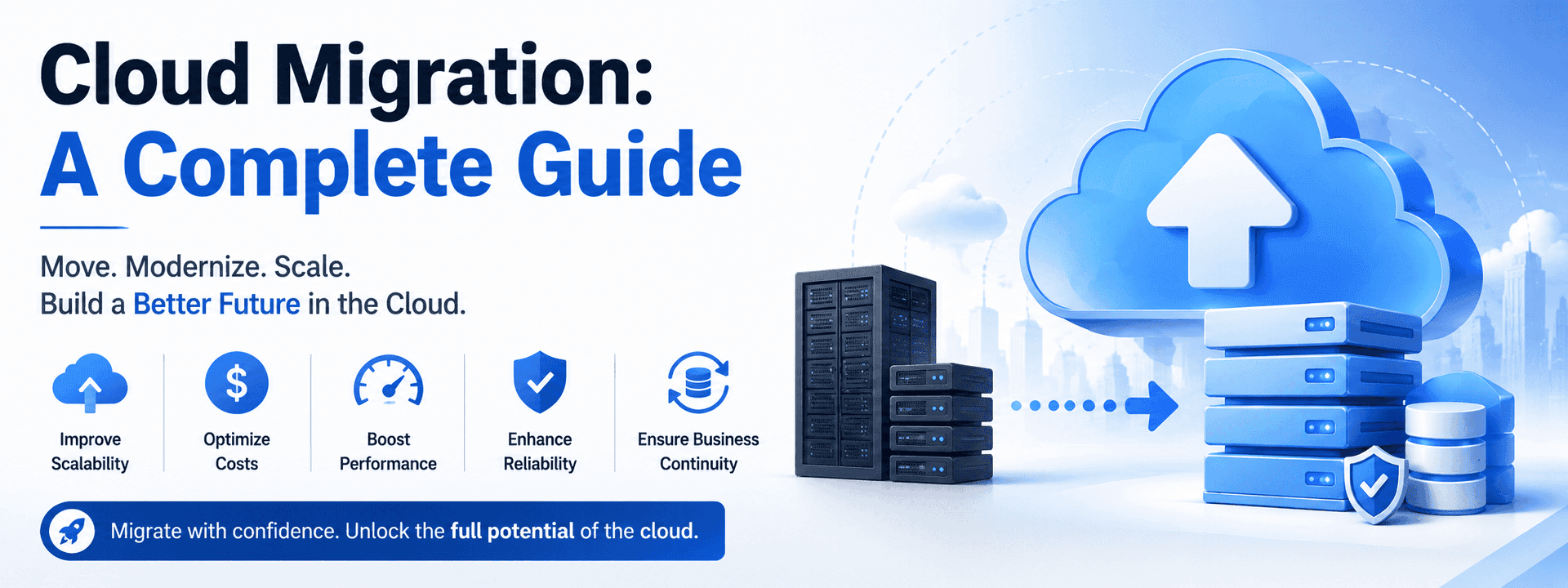
One of the most significant benefits of cloud migration is the ability to scale infrastructure according to workload requirements.
Traditional infrastructure often requires businesses to purchase and provision resources in advance. This can result in either insufficient capacity during periods of high demand or unused resources during quieter periods.
Cloud infrastructure eliminates this friction through dynamic allocation. Whether you need on-demand resource provisioning, vertical or horizontal scaling, automated adjustment policies, or flexible storage capacity, the target environment adapts dynamically. This allows businesses to respond seamlessly to traffic spikes without paying for idle hardware during off-peak hours.
Cloud Cost Optimization
Cloud migration can help businesses improve infrastructure cost efficiency when resources are properly designed and managed. Instead of maintaining infrastructure based entirely on peak capacity, organizations can align resources far more closely with actual operational requirements.
Cost optimization comes from right-sizing overprovisioned instances, eliminating dead weight, optimizing storage tiers, and selecting instance types tailored to specific workloads. However, cloud migration does not automatically guarantee lower costs-a poorly architected cloud can quickly become expensive. Financial optimization must therefore be woven into both the migration plan and ongoing operational strategy.
Improved Infrastructure Performance
Cloud migration grants immediate access to newer hardware, optimized networking, high-speed storage technologies, and geographically distributed resources.
Depending on the target environment, businesses routinely see drastic performance gains. Applications respond faster, database query times drop, network latency shrinks, and storage throughput expands significantly. These performance improvements are particularly valuable for global applications serving users across multiple regions.
Better Infrastructure Reliability and Availability
Modern business applications increasingly demand continuous availability, and cloud platforms excel at delivering high-uptime architectures.
By leveraging redundancy, automated recovery routines, load balancing, multi-zone deployments, and distributed infrastructure, a properly designed cloud environment eliminates single points of failure and reduces dependence on individual physical servers. The key distinction here is design: cloud migration alone does not magically grant high availability, but building on a cloud foundation makes high availability achievable.
Enhanced Disaster Recovery and Business Continuity
Hardware crashes, software corruption, and unexpected outages can severely disrupt operations if your recovery plan is fragile. Cloud environments make it much simpler to build resilient, automated disaster recovery strategies. By utilizing automated offsite backups, real-time workload replication across multiple availability zones, geographic redundancy, and automated recovery scripts, a migration project offers the perfect opportunity to replace outdated backup routines with a robust business continuity model.
Faster Infrastructure Deployment
Provisioning traditional hardware can take days or weeks of manual effort, dragging down development momentum.
In contrast, cloud infrastructure allows teams to spin up environments in minutes. By leaning on automation, Infrastructure as Code (IaC), configuration management tools, cloud APIs, and modern CI/CD deployment pipelines, organizations drastically reduce the lead time required to launch new services or test production changes. This agility helps development and operations teams react instantly to shifting market demands.
Access to Modern Cloud Technologies
Migrating to the cloud opens the door to an entire ecosystem of advanced tools and fully managed services.
Instead of maintaining raw virtual machines, organizations can easily adopt container platforms like Kubernetes, managed database engines, serverless compute, and cloud-native monitoring solutions. Accessing these technologies helps teams modernize legacy applications, streamline DevOps workflows, and eliminate the overhead of managing underlying software stacks manually.
Improved Security and Infrastructure Management
Cloud providers offer extensive, enterprise-grade security tools, though businesses remain responsible for configuring their own environments correctly.
A migration project serves as an ideal checkpoint to overhaul your security posture. It forces a comprehensive review of firewall policies, access control management, identity policies, operating system hardening, network segmentation, data encryption, and centralized logging. Security shouldn't be treated as an afterthought; it works best when integrated directly into the migration pipeline.
Better Geographic Reach
For companies serving an international audience, operating out of a single physical location introduces unavoidable network latency.
Strategically deploying workloads across distributed cloud regions allows businesses to host applications closer to their end-users. This geographic flexibility slashes latency, enhances application responsiveness, accelerates market expansion, and helps meet strict local data residency requirements.
Strategic Value of Cloud Migration
While the technical advantages are clear, the true power of cloud migration lies in how it empowers broader business strategy.
Supporting Business Growth
Cloud infrastructure allows organizations to scale up their capacity in direct proportion to real demand. Instead of making risky, large capital investments in hardware ahead of time, resources can be scaled incrementally as the business evolves. This elasticity provides crucial operational support during seasonal traffic surges, major product launches, geographic expansions, or business acquisitions.
Improving Business Agility
In fast-moving markets, speed is a competitive advantage. Cloud infrastructure dramatically enhances organizational agility by simplifying how new testing environments are launched, how application updates are pushed, and how new technologies are integrated. By removing physical infrastructure bottlenecks, teams can focus on delivering value rather than battling server limits.
Enabling Infrastructure Modernization
Cloud migration often acts as the catalyst for deeper digital transformation. Once a workload is safely running in the cloud, teams can gradually introduce containerization, Kubernetes orchestration, CI/CD automation, and cloud-native design. This progressive approach allows organizations to modernize their tech stack steadily without risking a chaotic, all-at-once overhaul.
Reducing Infrastructure Management Burden
Managing physical hardware requires substantial time, labor, and ongoing maintenance costs. Moving to the cloud frees internal teams from the burden of hardware procurement, data center maintenance, component replacements, and physical capacity forecasting. This operational shift allows your engineers to redirect their focus toward application performance, internal automation, and core business goals.
Cloud Migration vs Cloud Modernization
While frequently used interchangeably, cloud migration and cloud modernization represent two distinct strategies.
Cloud migration focuses primarily on transferring existing workloads from one environment to another - such as shifting a legacy application from a VPS to a cloud instance with minimal architectural changes. Cloud modernization, on the other hand, actively refactors how an application is designed and operated to leverage cloud-native features, like converting a monolithic setup into containerized microservices managed by Kubernetes.
The first approach gets your foot in the door; the second maximizes the long-term potential of the cloud platform.

Common Cloud Migration Challenges
Despite the clear benefits, migrating production workloads introduces significant technical complexity.
Engineers must navigate tricky data migrations, complex application dependencies, DNS cutovers, network routing adjustments, and real-time database synchronization. Storage transfers, security permissions, downtime limits, performance validation, and rollback planning all require precise execution. These challenges compound during cloud-to-cloud moves, where source and destination platforms often rely on fundamentally different networking models, APIs, and storage architectures.
How to Minimize Cloud Migration Risks
To execute a seamless transition without unexpected downtime, organizations should follow a disciplined, multi-stage migration roadmap:
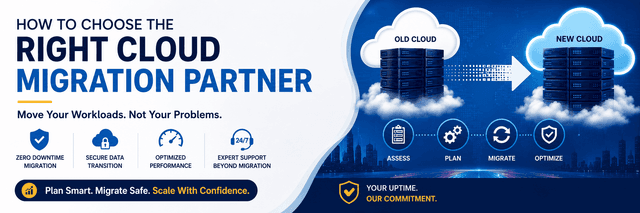
1. Infrastructure Assessment
Audit your current stack entirely. Map out every server, application, database, storage dependency, and traffic pattern before touching a line of code.
2. Migration Planning
Establish a clear execution sequence. Define your target architecture, acceptable downtime windows, data synchronization tools, and fallback rollback procedures.
3. Data and Workload Migration
Execute the data transfer using methods tailored to your specific application architecture and uptime requirements.
4. Testing and Validation
Thoroughly verify application logic, database integrity, network connectivity, DNS records, performance metrics, and security controls before going live.
5. Controlled Cutover
Transition production traffic over to the new environment using a carefully orchestrated cutover strategy.
6. Post-Migration Monitoring
Keep a close eye on system vitals immediately following the cutover to catch performance anomalies or configuration gaps early.
Why Post-Migration Support Matters
A successful migration doesn't end the moment DNS records update and traffic shifts. The new environment requires continuous, proactive operational care to stay healthy.
Long-term stability demands continuous server monitoring, ongoing performance tuning, security event tracking, routine Linux administration, and active capacity planning. Partnering with dedicated operational experts ensures that your newly migrated environment remains lean, secure, and fully optimized, especially if you lack an internal 24/7 cloud management team.
How SupportSages Supports Cloud Migration
SupportSages helps businesses navigate complex infrastructure migrations with an emphasis on zero data loss, minimal downtime, and complete operational stability.
Whether you are planning a cloud-to-cloud move, migrating from legacy VPS/dedicated servers, or adopting Kubernetes, SupportSages bridges the gap between initial transition and long-term management. From hands-on Linux administration and security hardening to 24/7 infrastructure monitoring, performance optimization, and rapid incident response, our engineering services ensure your environment stays reliable long after the cutover is complete.
Questions to Ask Before Starting a Cloud Migration
Before launching a migration project, bring your engineering and leadership teams together to answer these fundamental questions:
● What are the specific business drivers behind this migration?
● Which workloads make sense to migrate first, and which require architectural changes?
● How much downtime can the business realistically tolerate during cutover?
● What is our strategy for real-time database synchronization and DNS cutover?
● Do we have a fully tested rollback plan if something unexpected occurs?
● Is the target cloud environment properly sized and cost-optimized?
● Who will handle 24/7 monitoring, security updates, and infrastructure management after we go live?
Final Thoughts
Cloud migration is far more than an exercise in moving bits and bytes between servers. When planned and executed with care, it transforms your underlying infrastructure into a flexible, secure, high-performing foundation built for long-term growth.
However, capturing the full value of the cloud requires more than clicking "deploy." Success depends on thorough assessments, smart architectural choices, precise migration execution, rigorous security checks, and reliable post-migration management. By taking a strategic approach, you can build an infrastructure environment that isn't just hosted in the cloud, but actively propels your business forward.