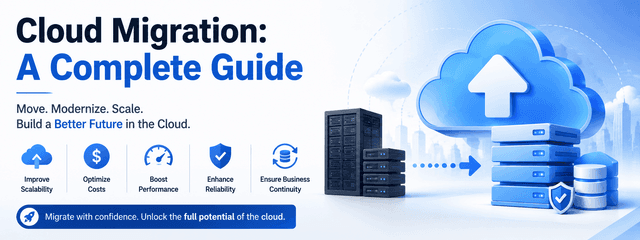



There was a time when moving to the cloud was a one-way trip. You picked a provider, migrated your workloads, and settled in. Today, things look very different. Cloud-to-cloud migration has become a standard operational play. As businesses scale, mature, and face shifting market realities, they often find themselves outgrowing their initial infrastructure setup.
Whether it is driven by creeping cloud spend, performance ceilings, a frustrating support experience, or the need to modernize from basic virtual servers to containerized environments, the question is no longer if you should move, but how to do it cleanly. Yet, shifting production workloads between different cloud platforms is not as simple as copying files from one server to another. It is an intricate operation that involves moving live databases, active DNS configurations, complex firewall policies, SSL certificates, load balancers, and containerized workloads—all while your users expect zero disruption. To pull this off, you don't just need a standard vendor; you need a migration partner who understands how infrastructure breathes. Here is how to navigate the process.
Why Businesses Are Switching Cloud Providers
Cloud migration today is rarely about first-time cloud adoption. Instead, it is an optimization strategy focused on four key areas:
● Cost Realignment: At scale, pricing structures differ drastically. A business might migrate to optimize bandwidth costs or find better value on dedicated infrastructure to keep operational expenses under control.
● Latency and Regional Availability: Geography matters. Moving workloads closer to a shifting customer base can shave crucial milliseconds off application response times, directly boosting user experience and conversions.
● Infrastructure Modernization: Many migrations serve as the perfect opportunity for an architectural upgrade—transitioning legacy VPS setups into high-availability clusters or fully containerized DevOps workflows.
● Operational Peace of Mind: Sometimes, the move is sparked by poor provider support or unreliable underlying hardware. Migrating becomes the fastest path to better operational stability and stronger uptime guarantees.
Why Cloud-to-Cloud Migration is Harder Than It Looks
Unlike basic website transfers, a live production environment is an interconnected web of dependencies. If your application, database, API, and mail infrastructure aren't moved in a synchronized, calculated sequence, things break. Without meticulous planning, a cloud migration can trigger a cascade of issues: prolonged downtime, data inconsistency between the old and new databases, broken third-party integrations, and frustrating DNS propagation delays. A true migration partner doesn't just focus on the target destination; they obsess over the transition phase.
[Traditional Approach] ---> [Sudden Cutover] ----> [Unexpected Downtime & Errors]
vs.
[Proactive Approach] ---> [Live Sync Loops] ---> [Seamless DNS Switchover]
How to Choose a Cloud Migration Partner: Key Capabilities to Evaluate
When evaluating an infrastructure team to guide your move, look for capabilities that extend far beyond a basic deployment checklist.
1. Deep Technical Expertise in Linux and Cloud Networking
Cloud consoles make things look simple with graphical interfaces, but underneath it all runs an operating system. You need seasoned Linux system administrators who understand kernel limits, database tuning, and network routing. If a team only knows how to click buttons in a dashboard but doesn't understand the underlying OS architecture, troubleshooting a post-migration performance bottleneck becomes a finger-pointing match.
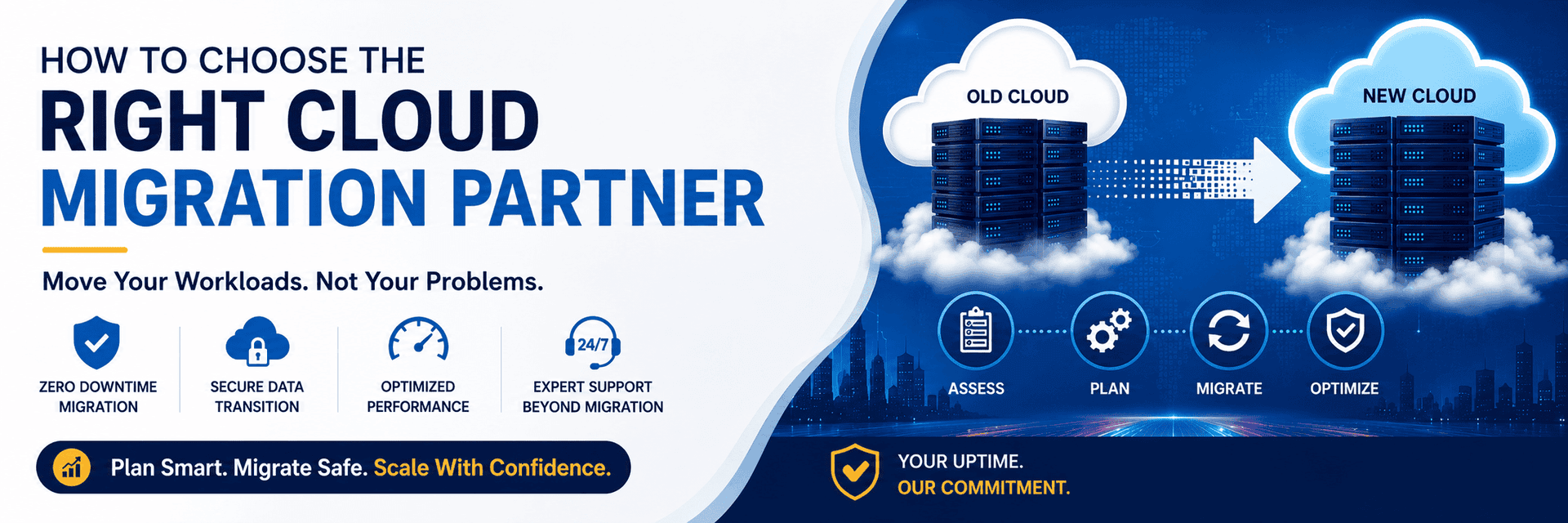
2. Zero Downtime Cloud Migration: What a Real Strategy Looks Like
A generic "we'll take the site down for maintenance at midnight" approach doesn't cut it for modern, always-on businesses. A professional partner relies on live, replication-based migrations, keeping the source and destination environments synchronized in real-time right up to the exact millisecond of the DNS cutover.
3. Cloud Migration Security: Protecting Data During the Transition
Moving data across infrastructure providers exposes sensitive business assets. Your partner must integrate security directly into the migration pipeline, ensuring data is encrypted in transit, firewalls are hardened in advance, and access policies are tightly configured before a single user hits the new environment.

Pre-Migration Cloud Infrastructure Assessment: Why It Can't Be Skipped
The most common reason cloud migrations stumble is a lack of prep work. A successful project always begins with a comprehensive audit of your current footprint. Before moving a single byte, you must analyze real-world resource utilization, map out tight network dependencies, examine storage growth trends, and evaluate traffic patterns. This upfront assessment prevents you from over-provisioning (and overpaying) in your new home, ensuring the target environment is perfectly sized from day one.
Post-Migration Support: What Happens After the Cloud Switch
A migration doesn't end when the data transfer shows "100% Complete." In reality, the true test begins the moment live production traffic hits the new infrastructure. Hidden configuration quirks, minor resource spikes, or caching mismatches often surface only under real-world user loads.This is why ongoing, proactive monitoring is non-negotiable.
At SupportSages, we treat cloud migration as the starting line, not the finish line. By embedding continuous server monitoring into our post-migration process, our engineers keep a close eye on resource growth, database health, and security events. We catch and tune the inevitable post-migration anomalies long before they can escalate into user-facing incidents.
Final Thoughts
Migrating between cloud platforms shouldn't feel like a high-stakes gamble. When approached strategically with deep pre-migration planning and robust post-migration oversight, it becomes a powerful catalyst for your company's growth, efficiency, and reliability.
At SupportSages, we specialize in removing the friction from complex infrastructure moves. We handle the heavy lifting, the replication loops, and the architecture tuning—so your team can stay focused on building your product.
Evaluating a shift in your cloud infrastructure? Let’s talk about how to move your workloads safely, predictably, and with zero surprises.